Short-Term vs Long-Term Gains
The IRS distinguishes between two types of capital gains based entirely on how long you held the asset before selling:
Short-term capital gains apply to assets held for one year or less. They're taxed as ordinary income — at whatever your marginal income tax rate is. For a 22% bracket taxpayer, short-term gains are taxed at 22%. For top earners, that's 37%.
Long-term capital gains apply to assets held for more than one year (at least one day over 365). They're taxed at preferential rates: 0%, 15%, or 20%. The tax code deliberately rewards long-term investment over short-term speculation.
This distinction applies to stocks, bonds, ETFs, mutual funds, real estate, and other capital assets. It applies regardless of whether you hold them in a brokerage account — investments in tax-advantaged retirement accounts (401k, IRA) don't generate taxable capital gains at all until withdrawal.
2026 Long-Term Capital Gains Rates
| Rate | Single Filer (Taxable Income) | Married Filing Jointly |
|---|---|---|
| 0% | Up to $48,350 | Up to $96,700 |
| 15% | $48,350 – $533,400 | $96,700 – $600,050 |
| 20% | Above $533,400 | Above $600,050 |
Source: IRS Rev. Proc. 2025-40. Taxable income after deductions. Note: A 3.8% Net Investment Income Tax (NIIT) also applies to investment income for those with MAGI above $200,000 (single) or $250,000 (MFJ), making the top effective long-term rate 23.8%.
The 0% rate is genuinely valuable and underutilised. A married couple with combined taxable income under $96,700 pays no federal capital gains tax on long-term investment profits. Strategically realising gains in low-income years — retirement transitions, career gaps, sabbaticals — can permanently eliminate capital gains tax on years of investment growth.
How Capital Gains Are Calculated
The capital gain (or loss) is simply the difference between your proceeds (what you sold for) and your cost basis (what you paid, including commissions and fees).
Cost basis: What you paid for the investment, plus any reinvested dividends (which you already paid tax on), adjusted for stock splits. Your brokerage tracks this for you and reports it on Form 1099-B.
If you sell multiple lots of the same stock purchased at different times, the specific lot identification method (selling specific shares by date and price) gives you control over whether you're selling short-term or long-term positions, and at what cost basis. Your brokerage typically uses FIFO (first-in, first-out) by default — but you can often instruct them to use specific lots.
Strategies to Minimise Capital Gains Tax
Hold for more than one year. The most straightforward strategy. If you're close to the one-year mark on a winning position and don't need to sell, waiting for the anniversary date can dramatically reduce your tax bill.
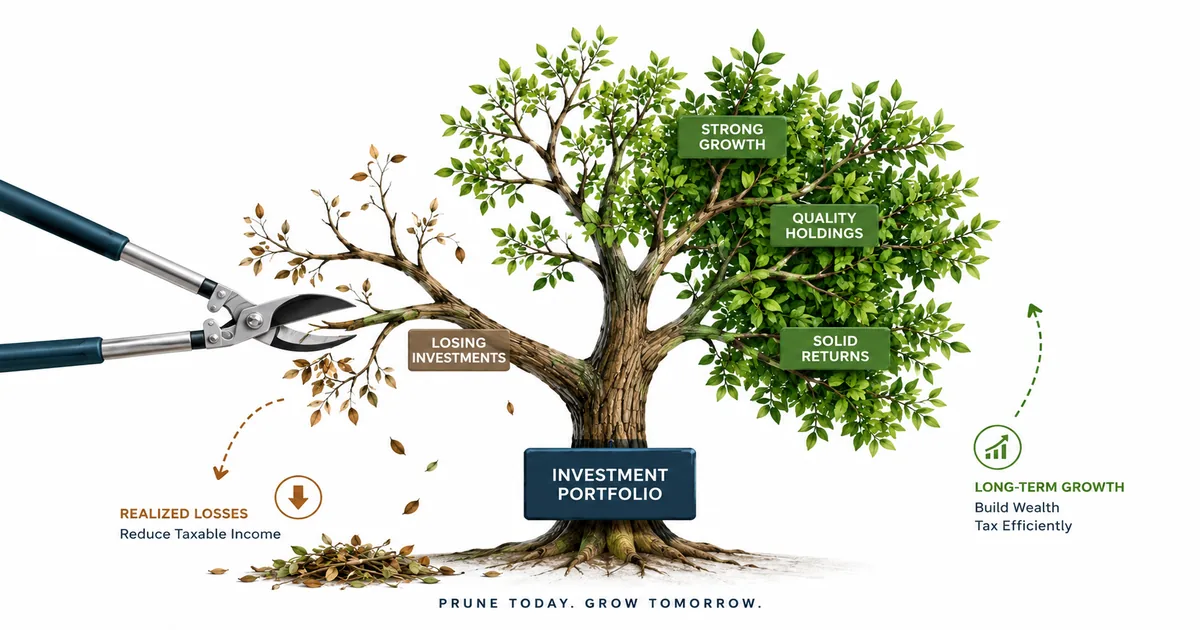
Tax-loss harvesting. Sell investments that are down to realise a capital loss. These losses offset capital gains — long-term losses offset long-term gains; short-term losses offset short-term gains; excess losses of either type can offset the other. Losses beyond gains can offset up to $3,000 of ordinary income per year, with the rest carrying forward to future years. After selling, you can immediately reinvest in a similar (but not substantially identical) investment. The wash-sale rule prevents you from repurchasing the same investment within 30 days.
Use tax-advantaged accounts. Investments inside a 401(k) or Traditional IRA grow tax-deferred — no capital gains tax until withdrawal. Investments inside a Roth IRA grow completely tax-free — no capital gains tax ever. Taxable brokerage accounts should hold tax-efficient investments (index funds with low turnover); tax-inefficient assets (bond funds, actively managed funds, REITs) are better placed in retirement accounts.
Harvest gains in 0% rate years. If your income drops below the 0% threshold, consider selling appreciated positions to reset your cost basis at a higher level — paying no tax now, and reducing future gains.
Gift appreciated assets to charity. Donating appreciated stock to a qualified charity avoids capital gains tax entirely and lets you deduct the full fair market value (subject to AGI limits). This is more tax-efficient than selling the stock, paying gains tax, and donating the proceeds.
Capital Gains on Home Sales
Home sales are subject to capital gains tax — but a generous exclusion protects most homeowners. If you've owned and lived in the home as your primary residence for at least 2 of the last 5 years before the sale, you can exclude:
- Up to $250,000 of profit if you're a single filer
- Up to $500,000 of profit if you're married filing jointly
Only gains above the exclusion are taxable. A married couple buying a home for $400,000 and selling for $850,000 realises a $450,000 gain — but excludes $500,000, meaning no capital gains tax at all. If the same couple sold for $1,000,000, the $600,000 gain minus the $500,000 exclusion leaves $100,000 taxable at long-term rates (assuming they held the home for over a year).
Capital Gains Tax in the UK, India, and Canada
UK — Capital Gains Tax: The UK charges CGT on gains from selling investments, second properties, and other assets — but not your primary home (Private Residence Relief excludes it). For 2026/27, CGT rates on gains from financial assets are 18% for basic-rate taxpayers and 24% for higher and additional rate taxpayers. The annual CGT allowance was reduced significantly — it's £3,000 for 2026/27. Gains within an ISA (Stocks and Shares ISA) are completely CGT-free — making ISAs extremely valuable for investors. HMRC details at gov.uk/capital-gains-tax.
India — Capital Gains Tax: India distinguishes between short-term and long-term gains with specific rules by asset class. For listed equities held more than 12 months: long-term gains above ₹1 lakh are taxed at 12.5% (LTCG tax). Short-term gains on listed equities: 20% (STCG). Debt funds and other assets have different holding periods and rates. Gains within an ELSS fund (held 3 years) or PPF are exempt. The Securities Transaction Tax (STT) is levied on equity transactions at the exchange. Details at incometaxindia.gov.in.
Canada — Capital Gains: Canada taxes 50% of capital gains (the "inclusion rate") as ordinary income. In other words, if you realise a $10,000 gain, $5,000 is added to your income and taxed at your marginal rate. The inclusion rate was proposed to increase to 2/3 for gains above $250,000 in 2024 but faced significant political opposition — verify current rules at canada.ca. The principal residence exemption eliminates capital gains on a home sale if it was your principal residence every year you owned it. Gains inside a TFSA are completely tax-free — making the TFSA particularly valuable for equity investors.