How Checking Accounts Work
A checking account is designed for constant movement. You receive your salary via direct deposit, pay bills through it, use the linked debit card for purchases, and write cheques (less common now). There are typically no limits on how many transactions you make per month.
In exchange for that flexibility, checking accounts pay very little interest — often 0.01% or nothing at all. The bank's value proposition here isn't yield; it's convenience. You can access your money instantly at any ATM or point of sale.
Most checking accounts come with a debit card, online and mobile banking access, bill pay, and the ability to link external accounts for transfers. Some offer overdraft protection — the bank covers a transaction when your balance runs short, usually charging a fee for doing so.
How Savings Accounts Work
Savings accounts are designed to hold money you're not spending right now. They pay interest on your balance — anywhere from the near-zero rates at big traditional banks to 4–5% at online banks (high-yield savings accounts).
Savings accounts traditionally limited withdrawals to 6 per month under a Federal Reserve rule called Regulation D, though that rule was relaxed in 2020. Many banks still impose their own limits as a matter of policy. The practical implication: a savings account isn't meant for daily use.
Side-by-Side Comparison
| Feature | Checking Account | Savings Account |
|---|---|---|
| Primary purpose | Daily spending and cash flow | Storing money, earning interest |
| Typical interest rate | 0.01% or none | 0.45% average; 4–5% at online banks |
| Debit card | Yes | Usually no |
| Transaction limits | Unlimited | May be limited (6/month at some banks) |
| Cheques / bill pay | Yes | Usually no |
| FDIC insured | Yes (up to $250k) | Yes (up to $250k) |
| Best for | Salary, bills, daily purchases | Emergency fund, savings goals |
APY figures as of May 2026. Source: FDIC national rate averages.
How to Use Both Together
The most effective approach for most people is a two-account setup:
Checking account: keep 1–2 months of essential living expenses here. This is your operational account. Your salary goes in, your rent and bills go out. You use the debit card for daily spending. Keep enough to cover your largest upcoming bills comfortably — but don't park thousands here earning nothing.
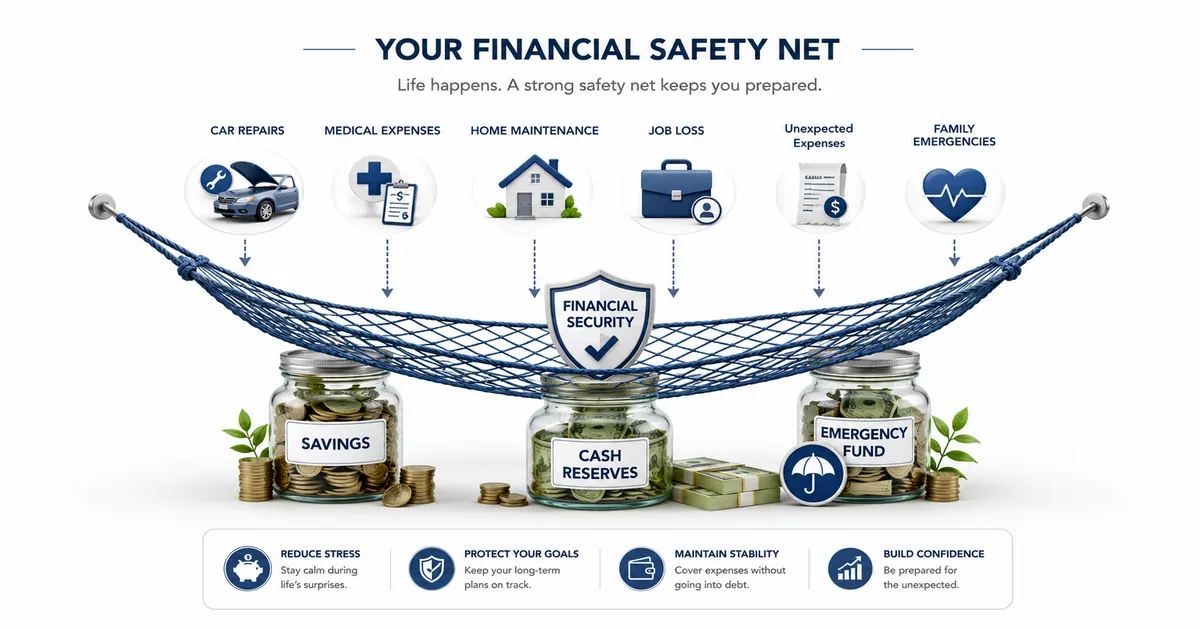
High-yield savings account: everything beyond that buffer goes here. Your emergency fund (3–6 months of expenses). Your house down payment savings. Your holiday fund. Any cash you're accumulating for a goal within the next 1–3 years. At 4–5% APY, this money is actively working while it waits.
A $15,000 emergency fund sitting in a 0.01% checking account earns $1.50 per year. The same amount in a 5% HYSA earns $750 per year — $748.50 more, for exactly the same money, at the same bank safety level.
Fees to Watch Out For
Monthly maintenance fees. Many traditional banks charge $10–$15 per month if your balance drops below a minimum (often $1,500). That's $120–$180 per year — easily avoidable by choosing a no-fee online checking account or maintaining the minimum balance.
Overdraft fees. If you spend more than your balance, many banks charge $25–$35 per overdraft. Opt out of overdraft protection if your bank offers it — it's usually better to have the card declined than to pay a fee.
ATM fees. Using an out-of-network ATM often triggers a fee from both your bank and the ATM operator. Online banks frequently reimburse these fees; check before opening an account if ATM access matters to you.
Excessive withdrawal fees. Some savings accounts still charge $5–$10 per withdrawal above the monthly limit. Know your bank's policy before making frequent transfers.
Current Accounts and Savings in the UK, India, and Canada
UK: The UK equivalent of a checking account is a current account — used for salary, direct debits, standing orders, and daily spending. Most come with a debit card and contactless payments. The UK equivalent of a savings account works identically to the US version — easy-access savings accounts pay variable interest, while fixed-term accounts (equivalent to US CDs) lock in a rate. Challenger banks like Starling and Monzo offer current accounts with better rates and features than traditional high street banks. The FSCS protects up to £85,000 per bank. MoneyHelper has a comparison guide at moneyhelper.org.uk.
India: Indian banks offer savings accounts for both daily use and interest earning — there's less separation between "checking" and "savings" in the Indian banking system. Most savings accounts come with a debit card and are used for daily transactions as well as storing money. Interest rates on savings accounts range from 2.7% (large public sector banks like SBI) to 7%+ (small finance banks). Salary accounts offered by employers typically come with waived minimum balance requirements. The DICGC insures deposits up to ₹5 lakh per depositor per bank. Current accounts exist for businesses and offer no interest but unlimited transactions.
Canada: Canadian banks use the same terminology — chequing accounts for daily use, savings accounts for storing money. Major banks (RBC, TD, Scotiabank) typically charge monthly fees of $4–$30 for chequing accounts unless you maintain a minimum balance. Online options like Tangerine, EQ Bank, and Simplii Financial offer no-fee chequing with better terms. The CDIC insures deposits up to $100,000 per category at member institutions. More at canada.ca/banking.