Why an Emergency Fund Is Non-Negotiable
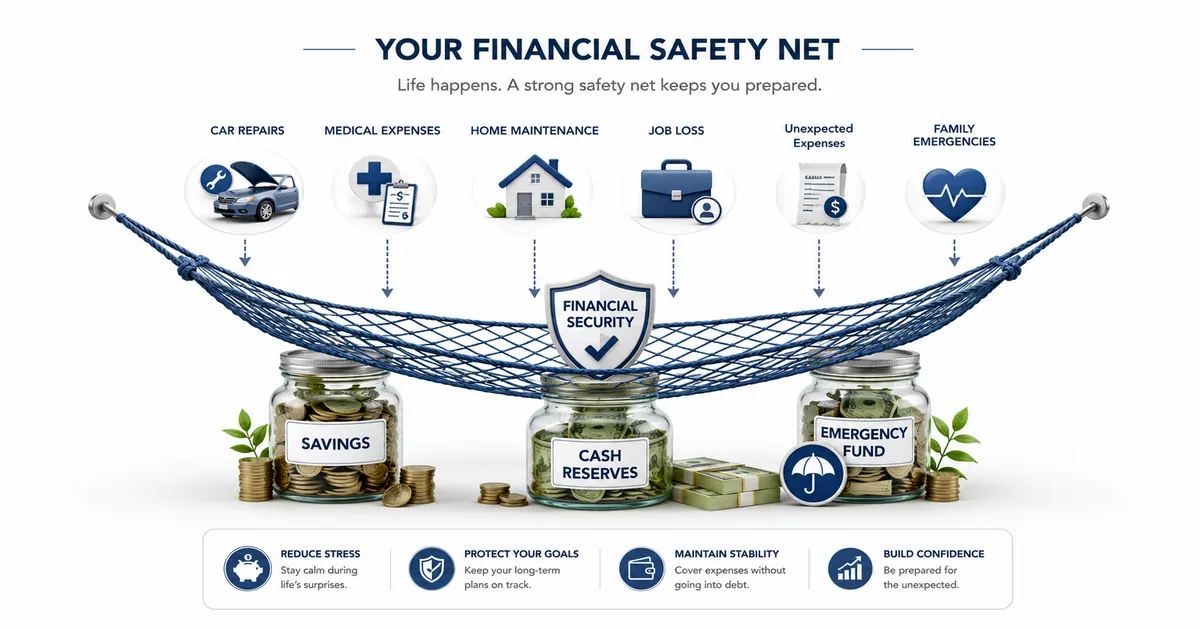
Without emergency savings, a single unexpected event — job loss, medical bill, car breakdown, appliance failure — forces you into high-interest debt. You borrow at 20%+ on a credit card to cover a $1,000 repair, then spend months paying it off. The emergency fund breaks this cycle entirely.
A 2024 Federal Reserve survey found that 37% of Americans could not cover a $400 emergency expense without borrowing or selling something. This isn't a fringe problem — it affects people across income levels. High-income earners with lifestyle inflation can be just as vulnerable as lower earners without savings habits.
The emergency fund isn't just about money — it's about options. Someone with 6 months of savings can leave a bad job, negotiate better rather than accept the first offer, and weather a health crisis without financial panic layered on top of physical stress.
How Much Do You Actually Need?
The standard advice is 3–6 months of expenses, but the right number depends on your specific situation:
| Situation | Target | Reasoning |
|---|---|---|
| Stable job, dual income household | 3 months | Two incomes buffer job loss risk |
| Stable job, single income household | 4–5 months | No income backup if you lose job |
| Variable income or self-employed | 6 months | Income fluctuates; no employer safety net |
| Industry with frequent layoffs | 6+ months | Job searches take longer in volatile sectors |
| Significant health issues or dependants | 6+ months | Higher probability of unexpected large expenses |
Calculate using your essential monthly expenses, not your total income or spending. Essential = housing + food + utilities + insurance + minimum debt payments.
Crucially: calculate essential expenses, not your full monthly budget. If you lost your job, you'd cut streaming services and dining out immediately. Your essential expenses — what you absolutely must cover to stay housed and fed — are the actual protection target. For most people, this is 60–70% of their regular spending.
Where to Keep Your Emergency Fund
Two non-negotiable requirements: it must be liquid (accessible quickly) and it must be safe (no risk of loss). This rules out stocks, bonds, and crypto — all of which can decline significantly exactly when the economy is stressed and you'd need the money.
The ideal home: a high-yield savings account (HYSA) at an FDIC-insured online bank. In 2026, competitive HYSAs pay 4–5% APY — turning a $15,000 emergency fund into one that earns $600–$750 per year while it waits. Transfer to checking in 1–3 business days when needed.
Keep it at a different bank from your main checking account. Having to initiate a transfer creates a small friction that prevents casual spending from the fund on non-emergencies. Out of sight, out of mind — but accessible when you need it.
How to Build It — Step by Step
Step 1 — Calculate your essential monthly expenses. List rent/mortgage, groceries, utilities, insurance premiums, minimum debt payments, transportation. Add them up. That's your monthly baseline. Multiply by 3–6 for your target.
Step 2 — Open a dedicated HYSA. Separate from your checking. Label it "Emergency Fund" explicitly — the label matters psychologically. Set up the account with auto-transfer enabled.
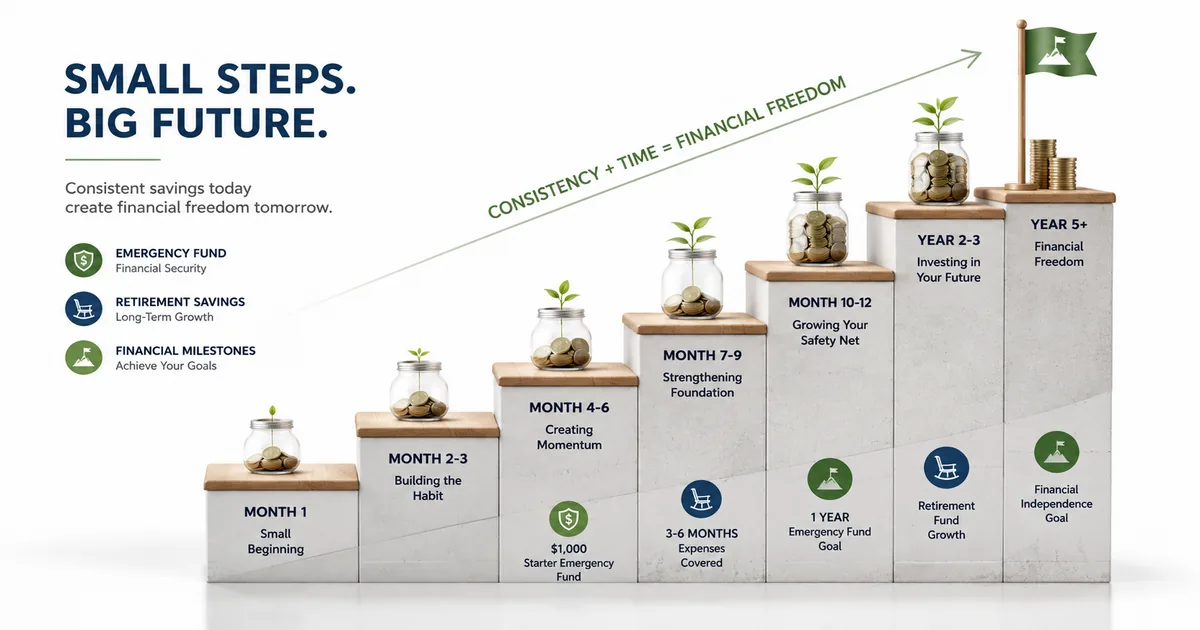
Step 3 — Set your savings rate. Start with whatever you can consistently manage — even $50/month. If you can do $500/month, a 6-month fund is built in 18 months assuming $4,500/month essential expenses. Consistency beats amount.
Step 4 — Automate on payday. Set the transfer to occur automatically the day your paycheck deposits. Pay yourself first — before discretionary spending can absorb it. Treat it like a bill, not an afterthought.
Step 5 — Set a $1,000 interim milestone. If the full target feels distant, $1,000 is a meaningful protective amount that covers most car repairs, medical copays, and minor home repairs. Celebrate this milestone — it's real progress.
Ways to Build It Faster
- Redirect windfalls. Tax refunds, bonuses, gifts, side income — all or most of these go straight to the emergency fund until the target is reached. A $2,000 tax refund significantly accelerates the timeline.
- Audit subscriptions. A 20-minute subscription audit typically uncovers $50–$100/month in services you'd forgotten. Redirecting those to savings adds $600–$1,200/year.
- Temporarily pause other savings. If you're starting from zero with high-interest debt, pause extra retirement contributions (beyond the employer match) and redirect to the emergency fund first. Building the fund removes the trigger for new high-interest debt.
- Sell unused items. Electronics, clothes, furniture — a focused weekend of selling can generate a lump sum contribution.
When to Use It — and When Not To
Legitimate emergencies: Job loss, medical bills, essential car or home repairs that affect safety or the ability to work, unexpected travel for a family emergency, major appliance failure.
Not emergencies: Planned purchases (even if urgent-feeling), holidays, sale items, wanting to avoid interest on regular expenses, or anything that was predictable with a week's notice. These belong in a separate sinking fund — a category in your budget saved for planned irregular expenses.
When you use the fund, replenishing it becomes your next financial priority — before extra debt payments, before additional investing, before discretionary spending increases. The fund must be restored to protect against the next event.
Emergency Savings in the UK, India, and Canada
UK: The same 3–6 month principle applies. UK residents face unique expenses not always covered by employers — national insurance gaps, benefit claim processing delays (Universal Credit has a 5-week initial wait), and high energy costs in winter. The best UK vehicle is an easy-access savings account or Cash ISA at a challenger bank (Marcus, Chip, Atom) paying 4–5% AER. The FSCS protects up to £85,000 per institution. MoneyHelper provides budgeting and savings tools at moneyhelper.org.uk.
India: Emergency savings in India face a balancing act: inflation can be higher than savings account rates at major banks. A practical approach: keep 1–2 months of expenses in a savings account for instant access, and the remaining 4–5 months in a liquid mutual fund (same-day redemption, typically 6–7% returns in 2026, marginally above savings rates). FD (Fixed Deposit) is another option but has penalties for early withdrawal. SEBI regulates liquid funds at sebi.gov.in. India's relatively limited social safety net makes a personal emergency fund especially important.
Canada: The standard 3–6 month target applies. The best vehicle is a HISA (High-Interest Savings Account) at EQ Bank, Wealthsimple Cash, or Oaken Financial (3–4.5% in 2026). A TFSA HISA is even better — the interest earned is completely tax-free, unlike a regular savings account where interest is taxable income. Canada's EI (Employment Insurance) provides up to 55% of earnings for up to 45 weeks if you lose your job, partially reducing how large the emergency fund needs to be — though the 2-week waiting period makes having savings critical. FCAC tools at canada.ca.