How the 50/30/20 Rule Works
The framework was popularised by Senator Elizabeth Warren and her daughter Amelia Warren Tyagi in their book "All Your Worth" (2005). The premise: most people fail at detailed budgeting not from lack of discipline, but because tracking every dollar is exhausting and unsustainable. Three categories are manageable. Fifty categories are not.
The first step is calculating your starting number: after-tax monthly income. Not your salary — your take-home pay after taxes, 401(k) contributions, and health insurance premiums. If your employer takes out 401(k) contributions automatically, those already count toward your 20% savings category — you don't need to budget them separately.
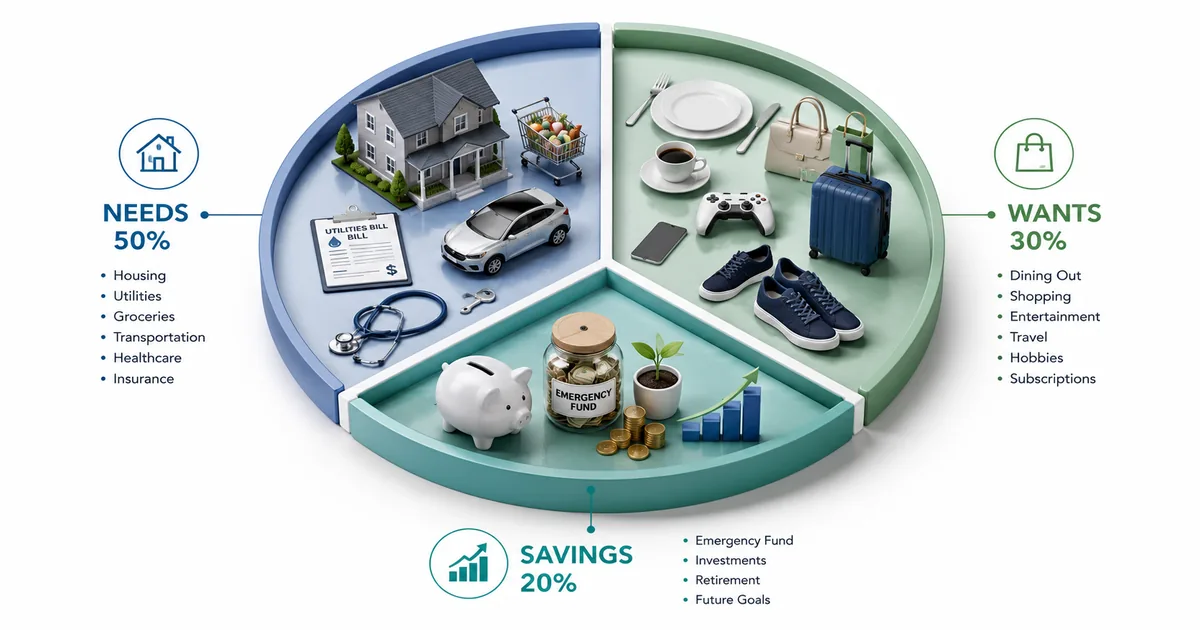
What Counts as a "Need"? (50%)
Needs are expenses you cannot skip without serious consequences — the payments that must happen regardless of what else is going on in your financial life.
- Rent or mortgage payment
- Groceries (not restaurant meals)
- Utilities — electricity, gas, water, basic internet
- Health insurance premiums and minimum medication costs
- Essential transportation — car payment, insurance, fuel, or transit pass for commuting
- Minimum payments on all debts (credit cards, student loans, car loans)
- Childcare (if required to work)
The honest reckoning: many things feel like needs that are technically wants. A gym membership you use every day still isn't a need. A car lease payment for a new car when you could own a reliable used car is partly a want. Being honest about this category is what makes the framework useful.
What Counts as a "Want"? (30%)
Wants are choices — things you spend on for enjoyment, convenience, or comfort beyond basic function. This is the category most people underestimate when they're surprised at the end of the month by where their money went.
- Restaurants, takeaways, coffee shops
- Streaming subscriptions (Netflix, Spotify, etc.)
- Gym memberships
- Clothing beyond essentials
- Holidays and travel
- Hobbies and entertainment
- Upgraded versions of things you could have more cheaply
The 30% wants allocation is not a permission slip to spend thoughtlessly — it's a defined limit that protects the savings category from being eroded by lifestyle spending. If wants are consuming 45% of income, the savings category is almost certainly suffering.
The 20% Savings Category
This is the most important category — the one that builds financial security over time. It covers:
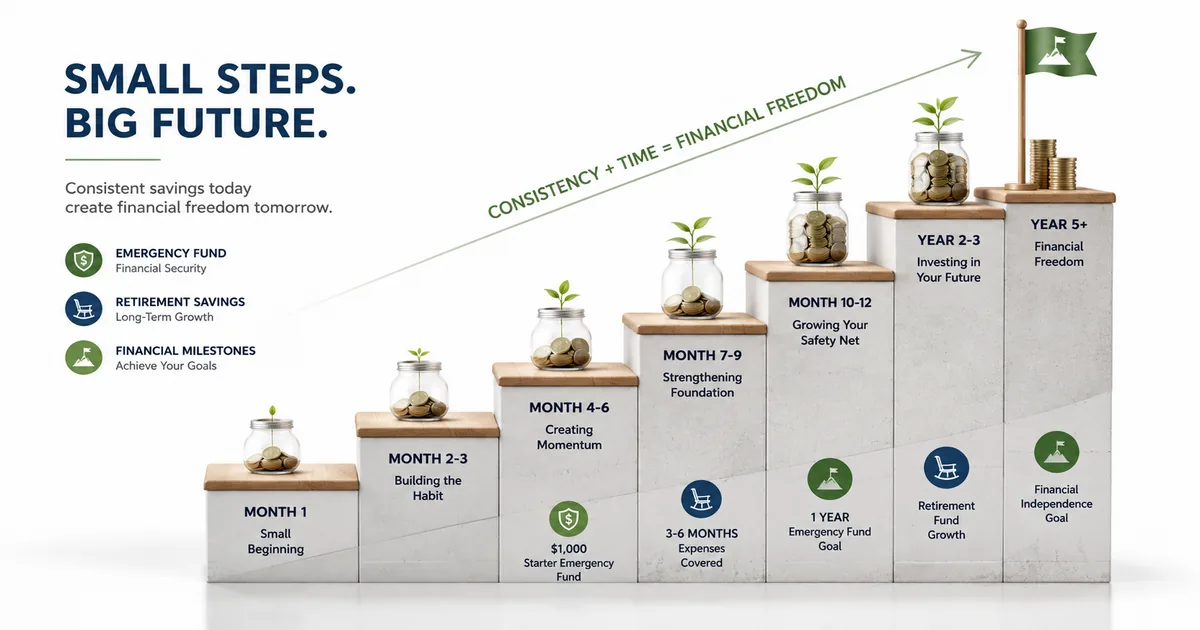
- Emergency fund contributions (until you reach 3–6 months of expenses)
- Retirement contributions — 401(k) above the employer match, IRA/Roth IRA
- Extra debt payments — above the minimums already in needs
- Other savings goals — house down payment, education, sinking funds
If your employer already takes 6% for a 401(k) from your gross pay, that's part of your 20%. The 20% target includes employer matches too — so if you contribute 6% and get a 3% match, you're at 9% and need another 11% from take-home pay to hit 20% of gross income. Most financial planners recommend saving at least 15–20% of gross income for retirement alone — the 50/30/20 rule's 20% savings category must prioritise accordingly.
A Worked Example
Monthly take-home pay: $4,500 (after taxes and employer 401k deductions).
| Category | Percentage | Monthly Amount | Examples |
|---|---|---|---|
| Needs | 50% | $2,250 | Rent $1,500, groceries $350, utilities $150, car insurance $150, minimum loan payment $100 |
| Wants | 30% | $1,350 | Dining $300, streaming $50, gym $60, clothing $150, weekend activities $200, misc $590 |
| Savings/Debt | 20% | $900 | Emergency fund $300, Roth IRA $300, extra student loan payment $300 |
Illustrative. Adjust categories to your specific income and cost of living.
When to Adjust the Percentages
High cost-of-living area: If housing alone is $2,000/month on $4,500 take-home, you're at 44% before anything else. Adjust to 60/20/20 rather than eliminating the savings category. Look for ways to reduce housing over time.
Aggressively paying off debt: Temporarily shift to 50/20/30 — keeping needs and wants stable, and redirecting the extra 10% from wants to the savings/debt category.
Building toward a major goal: A house down payment target may justify 50/20/30 for 2–3 years — reducing lifestyle spending to accelerate savings.
Low income: When income is genuinely low, even getting to 10% savings is meaningful progress. The percentages are a direction, not a rigid requirement. Start wherever you can and build toward them.
Budgeting Globally — UK, India, and Canada
UK: The 50/30/20 principle applies directly, though UK-specific factors matter. Housing costs in London and the South East routinely push the needs percentage above 50% for average earners — adjusting to 60/20/20 is common. Council Tax, which doesn't exist in the US, is a needs expense. The UK's NHS eliminates private health insurance as a mandatory need for most residents (a significant saving vs US counterparts). MoneyHelper has a free budget planner at moneyhelper.org.uk.
India: The 50/30/20 framework translates well to India with some adaptation. Housing costs in metros (Mumbai, Bangalore, Delhi-NCR) have risen sharply, potentially pushing needs above 50%. EMI payments on home loans, car loans, and consumer electronics are needs (minimum payments). The savings category in India often includes SIP (Systematic Investment Plan) contributions to mutual funds — an excellent vehicle for the 20%. The concept of saving for festivals, weddings, and family obligations (significant in Indian culture) needs to be explicitly included in either wants or savings. SEBI provides investor education at sebi.gov.in.
Canada: The framework applies similarly to Canada. Housing in Vancouver and Toronto often consumes 40–50% of take-home income alone for renters. RRSP and TFSA contributions naturally fit in the 20% savings category. The Canada Child Benefit (CCB) can be a meaningful supplement to income for families — factor it into take-home pay. FCAC provides a budget calculator at canada.ca.