Do You Actually Have to File?
Not everyone is legally required to file a federal tax return. For 2026, the general thresholds for single filers under 65 is gross income above $15,000 (equal to the standard deduction). But even if your income is below this threshold, you should file if:
- Federal income tax was withheld from your paychecks — you're likely owed a refund
- You qualify for refundable credits like the Earned Income Tax Credit (EITC) — which can generate a refund even if you owed no tax
- You had any self-employment income above $400 — self-employment tax kicks in at this level
- You received advance premium tax credits for health insurance — you must reconcile these
When in doubt: file. The downside of filing unnecessarily is minimal. The downside of not filing when required is penalties, interest, and complications. More at irs.gov/filing.
Documents You Need
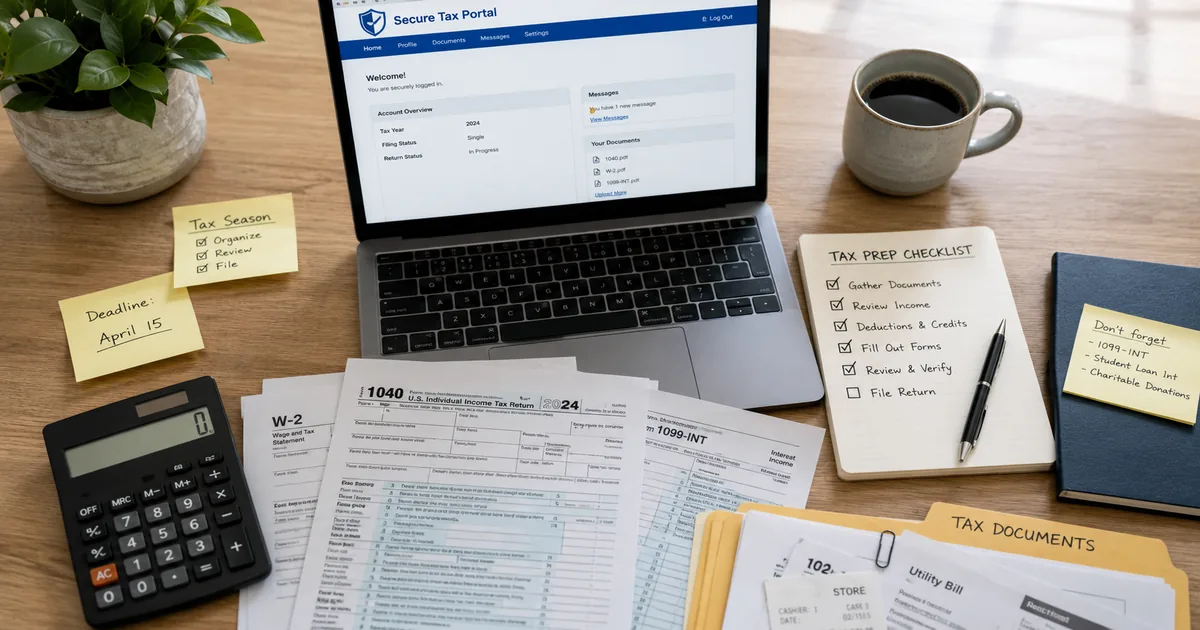
For most first-time filers with a simple tax situation, you need surprisingly few documents:
- W-2 form — sent by your employer by January 31. Shows your wages and taxes withheld. If you worked multiple jobs, you get a W-2 from each employer.
- Social Security Number (SSN) — your own, and those of any dependants you're claiming.
- Bank account details — routing and account number for direct deposit of your refund (optional but faster).
- 1099 forms — if you had freelance income (1099-NEC), interest income (1099-INT), dividends (1099-DIV), or other non-employer income.
- 1095-A — if you bought health insurance through the ACA Marketplace.
- Student loan interest statement (1098-E) — if you paid student loan interest.
- Last year's tax return — if applicable, for your prior year's AGI (needed for e-filing verification).
W-2s and 1099s are typically mailed and/or available online by January 31. Check your email, mailbox, and employer portal by mid-February.
Filing Methods Compared
| Method | Cost | Best For |
|---|---|---|
| IRS Free File | Free (AGI ≤ $79,000) | Most first-time filers — guided software through IRS website |
| Tax software (TurboTax, H&R Block, TaxSlayer) | $0–$129 federal | Slightly complex situations — multiple income sources, investments |
| VITA (in-person volunteer) | Free (income ≤ $67,000) | Those who prefer human help; complex family situations |
| CPA or tax professional | $150–$500+ | Self-employed, rental income, major life changes, complex situations |
| Paper filing | Postage only | Not recommended — slower, no real benefit for most filers |
IRS Free File: irs.gov/filing. VITA locations: call 800-906-9887 or search at irs.gov.
Step-by-Step Filing Process
Step 1 — Gather documents. Collect your W-2, SSN, and any 1099 forms. Set a reminder for late January when forms start arriving.
Step 2 — Choose your filing method. For a simple first return, IRS Free File or free versions of TurboTax/H&R Block work well. If you had only one employer and no investments, the free tier covers you completely.
Step 3 — Enter your personal information. Name, SSN, address, and filing status. The software guides you through each section.
Step 4 — Enter income. Input your W-2 details. If using software, you can often import your W-2 directly from your employer if they participate. Add any 1099 income.
Step 5 — Take deductions. For most first-time filers, the standard deduction ($15,000 for single filers in 2026) is automatic and better than itemising. The software applies it automatically.
Step 6 — Review and submit. The software calculates your tax liability, compares it to what was withheld, and shows your refund or balance due. Review carefully, then e-file.
Step 7 — Pay any balance or receive refund. If you owe, pay by April 15 (by bank transfer, debit/credit card, or IRS Direct Pay). If you have a refund, it typically arrives in 21 days with direct deposit.
Choosing Your Filing Status
Your filing status affects your tax bracket, standard deduction, and eligibility for various credits. The five options:
- Single: unmarried or legally separated as of December 31
- Married Filing Jointly: married couples combining income on one return — usually produces the lowest combined tax bill
- Married Filing Separately: married but filing separate returns — rarely beneficial, generally increases total tax
- Head of Household: unmarried with a qualifying dependant — provides a larger standard deduction than single
- Qualifying Surviving Spouse: widowed within the past two years with a dependent child
What Happens After You File
After e-filing, the IRS typically accepts or rejects within 24–48 hours. If accepted, you can track your refund at the IRS "Where's My Refund?" tool (irs.gov). Most e-filed refunds with direct deposit arrive within 21 calendar days. Paper check refunds take 4–6 weeks.
If rejected, the software tells you why (usually a typo in your SSN or prior year AGI) and lets you correct and resubmit. Keep a copy of your filed return — you'll need the prior year AGI for next year's e-filing verification.
Tax Filing in the UK, India, and Canada
UK — PAYE and Self Assessment: Most UK employees are taxed automatically through the PAYE (Pay As You Earn) system — your employer deducts income tax before paying you, and most employees never need to file a tax return. Self Assessment is required for the self-employed, those with income above £100,000, landlords, and others with complex situations. The Self Assessment deadline is January 31 for online filing (for the previous April 5 tax year end). HMRC provides free guidance at gov.uk/self-assessment.
India — ITR (Income Tax Return): India requires most earning individuals to file an Income Tax Return (ITR). The standard deadline is July 31 (for the previous financial year ending March 31). ITRs are filed online through the Income Tax e-Filing portal at incometaxindia.gov.in. Salaried individuals typically use ITR-1 (Sahaj) — the simplest form. Those with business income use ITR-3 or ITR-4. Form 26AS (your tax credit statement, showing TDS deducted) is essential for reconciliation. AIS (Annual Information Statement) provides a comprehensive view of all transactions.
Canada — T1 Personal Income Tax Return: Canadians file a T1 General tax return, due April 30 (June 15 for self-employed, though any balance is due April 30). Most employment income is reported on a T4 (equivalent to a US W-2). Canada Revenue Agency provides NETFILE-certified software (some free) for online filing. The CRA's Auto-fill My Return feature can import T4s, RRSP slips, and other information directly. Free tax clinics are available through the Community Volunteer Income Tax Program. More at canada.ca.