Why Online Banks Pay More
Traditional brick-and-mortar banks have enormous overhead — thousands of branches, teller staff, ATM networks, and physical infrastructure. They pass this cost to depositors by paying low interest rates. Online banks have none of this infrastructure — their cost structure is dramatically lower, and they compete for deposits primarily on interest rate. The result: online banks routinely pay 10–15 times the national average savings rate for the same FDIC-insured deposits.
The trade-off: online-only banks don't have physical branches. Deposits and withdrawals are done electronically (bank transfer, direct deposit, or ATM card). For most savers who rarely visit a branch, this is no trade-off at all.
What to Compare When Choosing a HYSA
| Factor | What to Look For |
|---|---|
| APY (Annual Percentage Yield) | Highest rate, but verify it's not a teaser rate that drops after 3–6 months |
| FDIC insurance | Must be FDIC-insured — all reputable online banks are |
| Monthly fees | Zero — avoid any account with a monthly maintenance fee |
| Minimum balance | Ideally $0 minimum to open and maintain; some require $1–$100 |
| Transfer speed | 1–3 business days to linked checking; some offer same-day or next-day |
| Mobile app | Check App Store ratings — you'll manage this account entirely online |
| ATM access | Some HYSAs provide a debit card with ATM reimbursements; most don't |
Verify rates at fdic.gov for current national average comparisons. Rates change with Federal Reserve decisions.
HYSAs for Emergency Funds
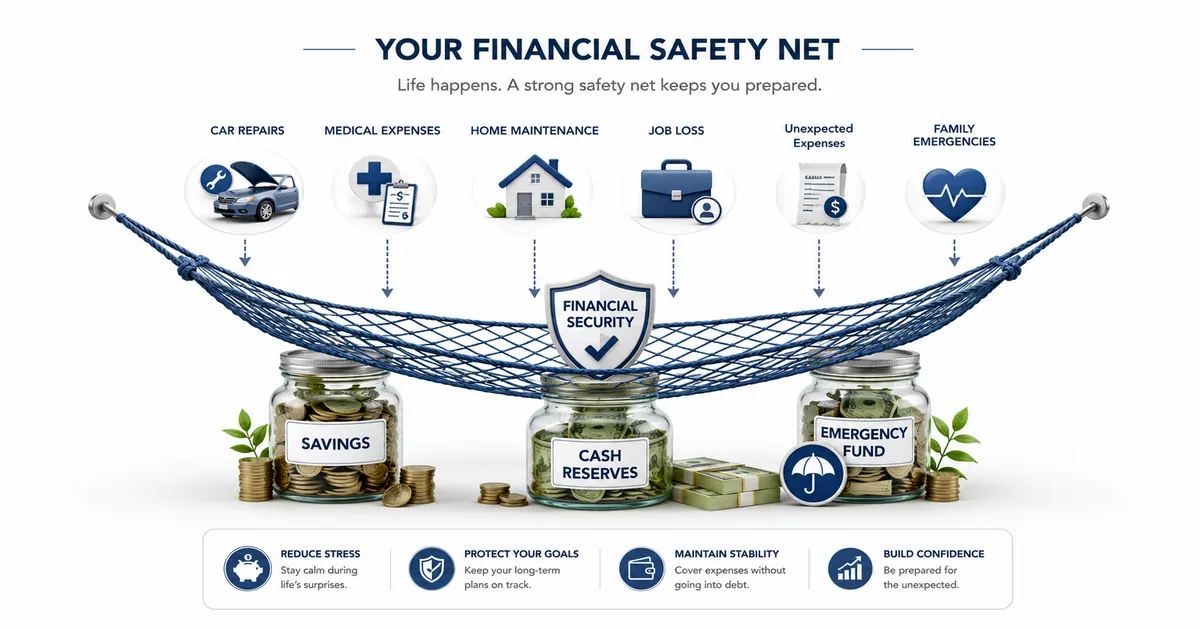
A high-yield savings account is the ideal home for your emergency fund — it's liquid (accessible within 1–3 days), FDIC-insured (no risk of loss), and earns meaningfully more than a standard savings account. Keeping your emergency fund at a different bank from your main checking account adds a small friction that prevents casual spending, while still making funds accessible within a business day or two when genuinely needed.
At 4.5% APY, a $15,000 emergency fund earns $675/year — not life-changing, but genuinely better than the $68/year it would earn at the 0.45% national average.
Limitations to Know
Rates are variable: HYSA rates are not fixed. They rise and fall with the Federal Reserve's interest rate decisions. When the Fed cut rates in 2024, HYSA rates dropped from their 2023 peaks of 5%+ to around 4–4.5%. When the Fed raises rates again, HYSA rates follow.
Not for long-term money: For money you won't need for 5–10+ years, a diversified investment portfolio historically outperforms a savings account significantly. HYSAs are for short-term savings and emergency funds — not retirement money.
Interest is taxable: HYSA interest is ordinary income taxable in the year received. You'll receive a 1099-INT each January.
High-Yield Savings Globally
UK: UK easy-access savings accounts at challenger banks (Marcus, Chip, Atom, Zopa) pay competitive rates — around 4–5% AER in 2026. Protected by the FSCS up to £85,000. Cash ISAs allow tax-free savings interest within the annual ISA allowance (£20,000/year). For regular savers, some building societies offer 7–8% AER on monthly contributions up to a cap. MoneyHelper at moneyhelper.org.uk.
India: Indian savings accounts at major banks pay 2.7–4% per annum — lower than the inflation rate in many years, creating a real return problem. Liquid mutual funds and overnight funds offer better returns (5–7% in 2026) with near-instant redemption, making them a better alternative for surplus cash. Fixed deposits lock money for a term but pay 6.5–7.5% at major banks. RBI at rbi.org.in.
Canada: Canadian HISAs (High-Interest Savings Accounts) at EQ Bank, Oaken Financial, and Wealthsimple Cash pay 3–4.5% in 2026. CDIC protects eligible deposits up to $100,000 per depositor per category. A TFSA HISA (available at most online banks) allows earning interest completely tax-free within your annual TFSA contribution room — the most tax-efficient savings vehicle for short-term money. FCAC at canada.ca.