Why Most Financial Goals Fail
The most common reason: they're aspirations, not goals. "I want to save more." "I need to pay off my debt." "I should invest." These statements describe a direction but provide no target, timeline, or mechanism. Without those three things, they remain permanently in the realm of intention.
The second most common reason: relying on willpower. Willpower is finite and unreliable. A goal that requires you to actively decide to save money every month will fail eventually — when life gets busy, when an emergency depletes motivation, when a temptation appears. Goals that are automated — where the saving happens before you have a choice — succeed without requiring ongoing willpower.
The third reason: too many competing goals. Trying to simultaneously build an emergency fund, pay off student loans, save for a house, and max a Roth IRA when your income barely covers expenses means spreading too thin to make meaningful progress on any single goal.
The SMART Goal Framework for Finances
SMART goals are Specific, Measurable, Achievable, Relevant, and Time-bound. Applied to finances:
- Specific: Name the exact amount and the exact account or purpose. Not "save for a house" but "save $20,000 for a down payment in a HYSA at [Bank]."
- Measurable: Monthly progress is trackable. $20,000 in 24 months = $833/month. You know every month if you're on track.
- Achievable: Run the math. $833/month is achievable on a $60,000 income if you live reasonably. $833/month is not achievable on $30,000 with $2,000/month in necessary expenses. Adjust the timeline before committing to an unachievable rate.
- Relevant: The goal connects to something you genuinely care about. A house for a family, retirement for security, debt freedom for peace of mind. Goals disconnected from values are hard to sustain.
- Time-bound: A deadline creates urgency. "Save $20,000 by March 1, 2028" is actionable. "Save $20,000 someday" is not.
Short, Medium, and Long-Term Goals
| Horizon | Timeline | Examples | Best Vehicle |
|---|---|---|---|
| Short-term | 0–3 years | Emergency fund, car purchase, vacation, electronics | High-yield savings account |
| Medium-term | 3–10 years | House down payment, pay off student loans, home renovation | HYSA or low-risk investments |
| Long-term | 10+ years | Retirement, financial independence, children's education | Tax-advantaged investment accounts (401k, IRA, Roth IRA) |
Match the vehicle to the timeline. Money needed within 3 years should not be in the stock market — it could be down 30% when you need it. Long-term money should not sit in a savings account — it will be significantly outperformed by a diversified index fund over 10+ years.
How to Prioritise When You Can't Do Everything
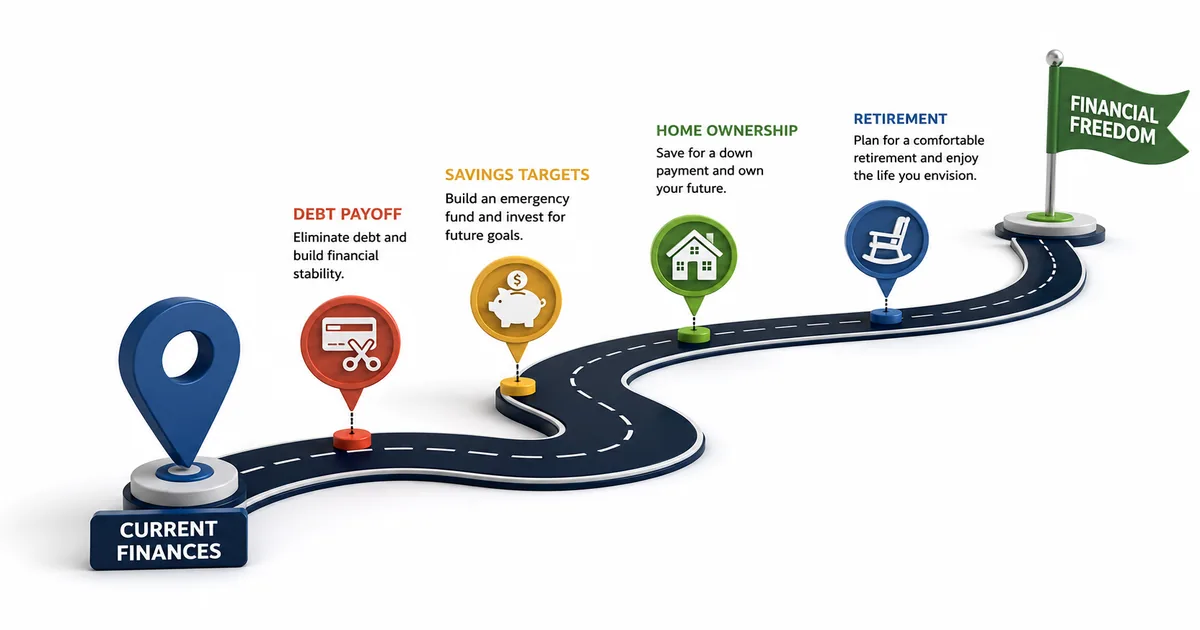
Most people can't pursue all financial goals simultaneously at full speed. A practical priority framework:
- Financial security first. $1,000 emergency fund and employer 401(k) match before anything else. These are the foundation — without them, one bad event undoes all other progress.
- Eliminate high-cost debt. High-interest debt (above 7–8%) is a guaranteed high return when paid off. It makes most other goals harder to achieve simultaneously.
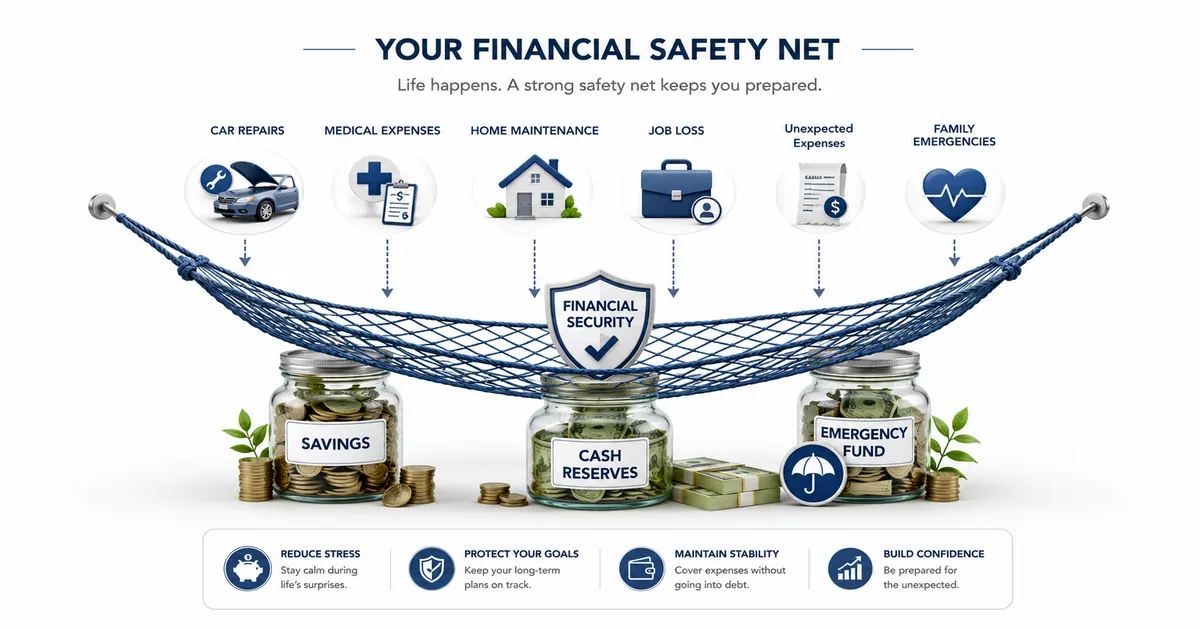
- Build the full emergency fund. Three to six months of essential expenses. This is when you get the ability to weather real storms.
- Medium-term goals in parallel with retirement. Once secure and debt-free (except mortgage), split progress between medium-term goals (house, education) and long-term retirement savings.
- Long-term wealth building. Maxing retirement accounts, then taxable investing, then estate planning — in that order.
Building the Systems That Make Goals Automatic
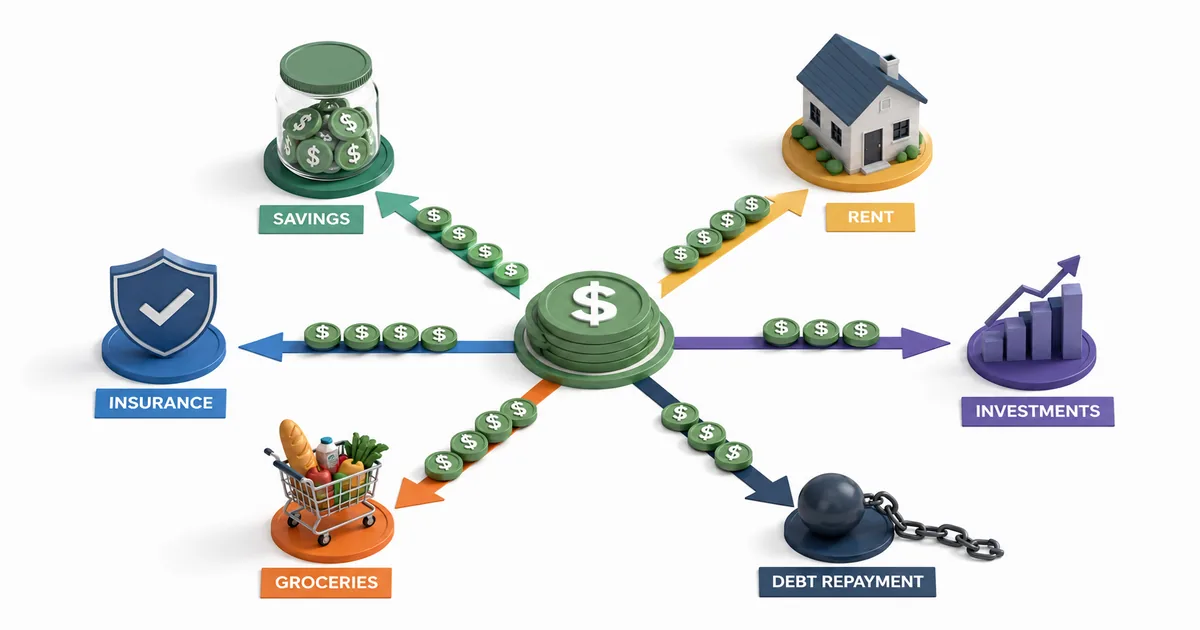
The most effective financial change you can make is setting up the right automatic transfers once and letting them run. Once automated, the goal advances every pay period without requiring willpower or memory.
Set up one account per goal. A HYSA account labelled "Emergency Fund" and another labelled "House Down Payment" keeps goals separate and visible. Mixing goal money in one account leads to fuzzy progress and easier raiding of funds.
Automate on payday. Set transfers to occur the day your paycheck lands — before any discretionary spending can absorb the money. Even if it's $100/month to start, the habit is the most important thing to establish.
Use sinking funds for irregular expenses. A sinking fund is money saved monthly for a known future irregular expense — car insurance, annual subscriptions, holiday gifts. Saving $150/month for a $1,800 annual car insurance payment prevents it from feeling like an emergency.
How to Track and Review Progress
Progress tracking doesn't need to be complex. A simple monthly check-in — 5 minutes looking at account balances versus targets — is sufficient for most goals. A quarterly review is ideal for bigger-picture assessment:
- Are all automated transfers running correctly?
- Are you on track for each goal? (current balance vs. required balance for the month)
- Have circumstances changed — income, expenses, new goals, completed goals?
- Is any goal consistently off track, suggesting the monthly target needs to be revised?
An annual net worth calculation anchors the long-term picture. Seeing net worth grow year over year — even by a modest amount — reinforces the value of the system and sustains motivation for the next year.
Financial Goal-Setting Globally
UK: UK financial goals follow similar structures. Short-term goals: ISA contributions, emergency fund (easy-access savings), pay off credit cards. Medium-term: Lifetime ISA for first home (4,000/year with 25% government bonus). Long-term: workplace pension top-up, SIPP contributions. The UK's defined-contribution pension auto-enrolment provides a built-in long-term saving mechanism — though most planners recommend supplementing it with additional ISA contributions. MoneyHelper has a goal-setting tool at moneyhelper.org.uk.
India: Financial goal-setting in India typically spans five categories: emergency fund (6 months, given limited social safety net), child education (starting from birth using PPF or mutual fund SIPs), home purchase (very culturally significant), retirement (using EPF, NPS, and mutual funds), and wealth accumulation. Goal-based investing through SIPs is the dominant approach — linking each SIP to a specific goal rather than investing a general pool. SEBI's financial education resources at sebi.gov.in.
Canada: Canadian goal frameworks parallel the US closely. Key vehicles: TFSA (tax-free, flexible — ideal for short and medium goals), RRSP (tax-deductible, retirement focus), FHSA (First Home Savings Account — up to $8,000/year, tax-deductible, tax-free for first home purchase). The FHSA is a powerful new account for first-time homebuyers introduced in 2023. CPP and OAS provide a retirement income floor that influences how much additional retirement saving is needed. FCAC tools at canada.ca.