What a Financial Plan Actually Is
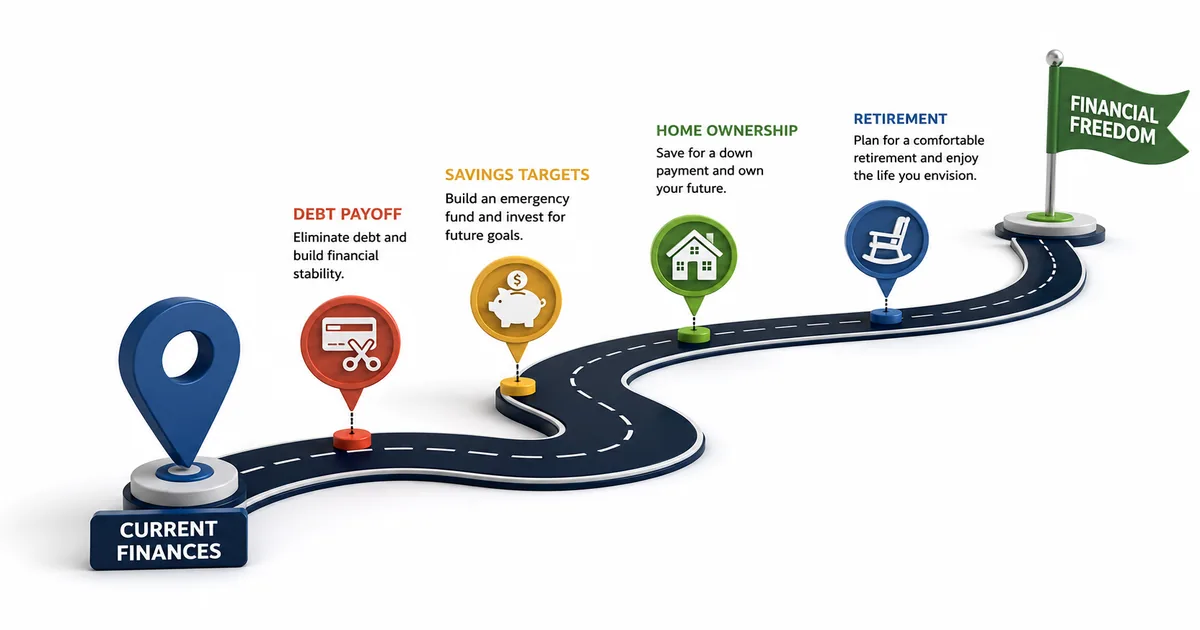
Most people imagine a financial plan as a thick document prepared by a financial advisor, full of projections and charts. That version exists — and if you're managing significant assets, it's valuable. But for most people in most situations, a financial plan is something far simpler: a clear picture of where you are now, where you want to go, and a prioritised set of actions connecting those two points.
The function of a financial plan isn't prediction — markets and life circumstances make accurate long-term prediction impossible. Its function is to give you a framework for making consistent decisions without having to rethink everything each time a financial situation arises. Should I pay off the student loan or invest the bonus? Should I buy or rent? Should I reduce my 401(k) contribution to save for a house? A financial plan gives you pre-made answers to these recurring questions.
Step 1: Take a Net Worth Snapshot
Your net worth — assets minus liabilities — is your financial position in a single number. It's not a measure of your worth as a person, and it's not a score. It's a coordinate: it tells you where you are on the map so you can navigate intelligently from this point.
Assets (what you own): Checking and savings accounts, investment accounts (401k, IRA, brokerage), home equity (market value minus mortgage balance), vehicles (current value), and any other significant assets.
Liabilities (what you owe): Mortgage balance, student loans, car loans, credit card balances, personal loans, and any other outstanding debt.
| Asset Category | Example | How to Value It |
|---|---|---|
| Liquid savings | Checking, savings, money market | Current balance |
| Invested assets | 401(k), IRA, brokerage accounts | Current market value |
| Real estate | Primary home, rental property | Estimated market value minus mortgage |
| Vehicles | Cars, motorcycles | Kelley Blue Book private sale value |
| Other assets | Jewellery, art, business interest | Realistic resale value (be conservative) |
Don't spend more than 30 minutes on this. Rough numbers are better than paralysing precision. Recalculate quarterly. The direction of travel — is net worth growing or shrinking over time? — matters more than any single snapshot.
Step 2: Analyse Your Cash Flow
Cash flow is the engine of your financial plan. A positive cash flow (income exceeding expenses) is the fuel for every other financial goal. Without it, you're building on sand — no matter how smart your investment strategy or how carefully you've selected your debt payoff method.
Calculate your monthly cash flow:
- Total monthly take-home income — salary, freelance, rental income, side income
- Minus essential expenses — housing, utilities, groceries, insurance, minimum debt payments, transport
- Minus discretionary expenses — dining, entertainment, subscriptions, clothing, travel
- Equals Available cash flow — this is what you have to work with for savings, debt payoff, and investing
If available cash flow is negative, your plan starts here — with expense reduction, income increase, or both. Every other step depends on having something left over each month.
The Cash Flow Optimisation Checklist
- Cancel subscriptions unused in the past 30 days
- Negotiate bills annually (insurance, internet, phone)
- Refinance high-rate debt if your credit score has improved
- Automate all savings — remove the temptation to spend what's there
- Review food spending — typically the easiest category to reduce without lifestyle impact
Step 3: Set Your Goal Hierarchy
Financial goals without timelines are wishes. The conversion from wish to plan happens when you add three things: a specific dollar amount, a target date, and a monthly savings requirement derived from both.
Goal: "I want to buy a house." Vague. Unactionable.
Goal: "I want a $60,000 house down payment by June 2028 (24 months). Required monthly savings: $2,500." This is a plan.
Goal Hierarchy Framework
Organise goals into three tiers. Never sacrifice Tier 1 for Tier 2 or 3.
- $1,000 emergency buffer
- Employer 401(k) match
- Essential insurance coverage
- Minimum debt payments
- Full emergency fund (3–6mo)
- High-interest debt payoff
- 15% retirement investing
- House down payment
- College savings
- Early retirement
- Travel / experiences
Step 4: Build Your Debt Strategy
Your debt strategy answers two questions: in what order should I pay off my debts, and how much extra should I pay each month? The answer to the first is almost always "highest interest rate first" (the avalanche method) unless you need psychological wins to stay motivated, in which case "smallest balance first" (snowball method) has strong empirical support from behavioural economics research.
List every debt: name, balance, interest rate, minimum payment. Calculate the total monthly minimum. Subtract from your available cash flow. Whatever remains is your debt acceleration budget — the extra money you can throw at debt each month above the minimums. Direct all of it to your target debt while paying minimums on everything else. When the target is eliminated, roll its payment to the next.
Step 5: Create Your Investment Allocation
Investment allocation is deciding what percentage of your invested money goes into what asset classes — primarily stocks vs bonds, and domestic vs international. The right allocation for you depends primarily on three factors: time horizon (how long before you need the money), risk tolerance (how much volatility you can stomach without panic-selling), and risk capacity (how much loss you could financially absorb).
| Years to Goal | Suggested Stock/Bond Split | Logic |
|---|---|---|
| 30+ years | 90–100% stocks | Long time horizon absorbs volatility; equities maximise return |
| 20–30 years | 80–90% stocks | Standard retirement allocation for mid-career investors |
| 10–20 years | 70–80% stocks | Gradual reduction in risk as goal approaches |
| 5–10 years | 50–70% stocks | Significant bond allocation to reduce sequence risk |
| Under 5 years | 0–30% stocks; rest in bonds or HYSA | Short horizon can't recover from a major downturn |
For most investors with 20+ years to retirement, a simple two-fund or three-fund portfolio handles allocation cleanly: a total US stock market index fund, an international stock index fund, and optionally a bond index fund. Rebalance annually. This beats the majority of actively managed portfolios after fees over long periods.
Step 6: Review Your Insurance Coverage
The insurance review is the most commonly skipped step in financial planning. People buy insurance and forget about it. But your coverage needs change as your life changes — a 25-year-old renting an apartment has completely different insurance needs than the same person at 38 with a mortgage, two children, and a business interest.
Annual insurance review questions: Is my life insurance death benefit sufficient to replace my income for my dependants? Is my disability policy an own-occupation definition? Have I updated beneficiary designations after major life events? Does my homeowners or renters coverage reflect current replacement costs? Would a $1–2M umbrella policy make sense given my current asset level?
The One-Page Financial Plan Template
📄 Your One-Page Financial Plan
Current Position
Net worth: $__________
Monthly income (take-home): $__________
Monthly essential expenses: $__________
Available cash flow: $__________
Top 3 Goals
1. __________ | $______ | By ______
2. __________ | $______ | By ______
3. __________ | $______ | By ______
Debt Summary
Total debt: $__________
Highest rate: __________% (target first)
Monthly extra payment: $__________
Monthly Allocations
Emergency fund: $__________
Retirement (401k/IRA): $__________
Other goals: $__________
Next Review Date: __________
Print this page, fill it in, and keep it somewhere visible. Review annually and after any major life change.
When to Review and Update Your Plan
Annual review (every January): Update net worth, review goal progress, adjust savings rates for income changes, rebalance investments, check insurance coverage adequacy.
After major life events: Marriage or divorce, having children, job change or significant income change, inheritance, major debt payoff, buying or selling a home, a serious health diagnosis in the family.
When markets do something dramatic: A plan review after a major market downturn ensures you don't make emotional decisions. The review should confirm your plan — not prompt you to abandon it.
Financial Plan Action Checklist
✅ Build Your Financial Plan — Step by Step
Common Financial Planning Mistakes
- Creating a plan and filing it away. A plan that isn't reviewed is just an exercise. The value comes from using it as a decision-making reference throughout the year.
- Setting goals without timelines. "I want to retire comfortably" is not a goal. "I want $1.5M by age 62, which requires saving $2,200/month starting now" is a goal.
- Optimising for taxes at the expense of behaviour. The most tax-efficient investment strategy is worthless if you panic-sell during a downturn. Behaviour beats optimisation.
- Not accounting for irregular expenses. Annual costs — car registration, insurance premiums, holiday travel, property tax — catch unprepared planners off guard. Divide annual irregular expenses by 12 and add that amount to your monthly budget.
- Planning for average returns. Monte Carlo simulations (available in most financial planning software) show ranges of outcomes. Build a plan that succeeds even in below-average return environments.