What Personal Finance Actually Is
Personal finance is simply the set of decisions you make about money — how you earn it, spend it, save it, protect it, and grow it over time. That's all it is. The subject sounds intimidating because it involves numbers, percentages, and a vocabulary that can feel exclusive. But the underlying logic is not complicated.
What makes personal finance genuinely difficult isn't the math. It's the behaviour. Spending feels good. Saving feels like deprivation. Investing feels risky. And nobody who taught you in school ever explained how any of it works together. So most adults make it up as they go, repeating the patterns they grew up with — which is why financial habits are so strongly correlated with the household you grew up in.
The good news: financial behaviour is learnable. And understanding the framework — which this guide provides — is 80% of the battle.
The Five Pillars of Personal Finance
Think of your financial life as a building. These five pillars hold it up. Neglect any one of them and the structure is unstable.
| Pillar | What It Does | What Breaks Without It |
|---|---|---|
| Budgeting | Tracks where money goes; creates awareness and control | Money disappears without explanation; can't make progress |
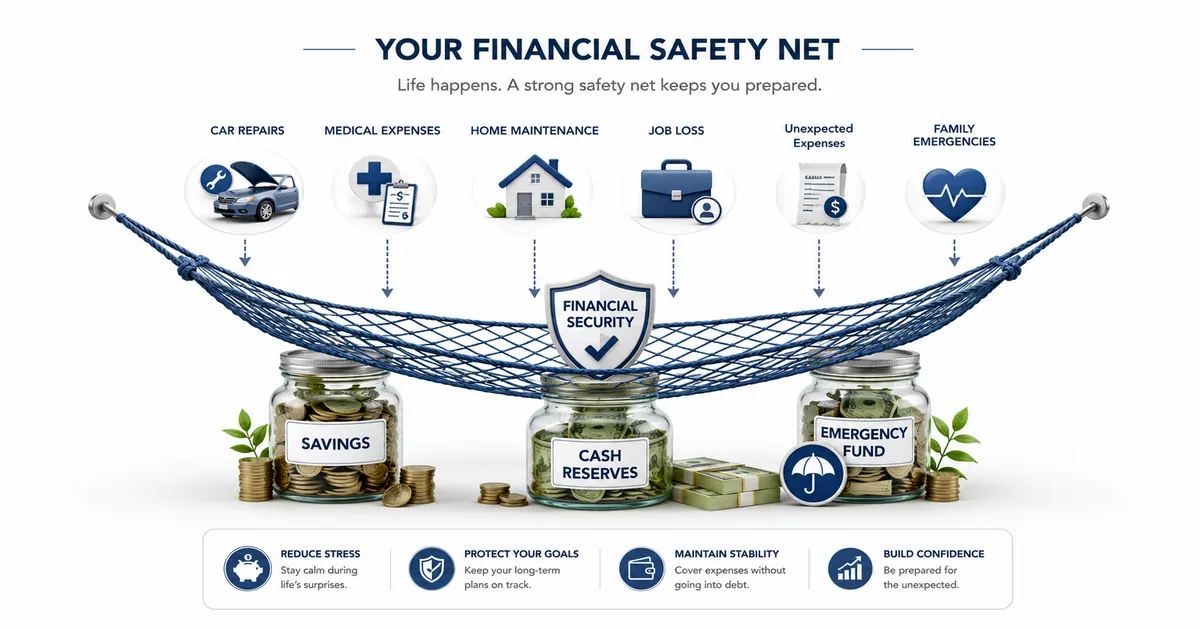
| Saving | Creates a financial buffer; prevents debt when life happens | Every unexpected expense becomes a crisis or new debt |
| Debt management | Reduces interest burden; frees cash flow for building wealth | High-interest debt compounds against you relentlessly |
| Investing | Grows wealth over time through compound returns | Inflation erodes savings; retirement security at risk |
| Insurance | Protects against catastrophic financial loss | One event (health crisis, lawsuit, fire) wipes out everything |
Most personal finance advice focuses on budgeting and saving, occasionally mentions investing, and largely ignores insurance. That's incomplete. The people who build lasting wealth understand all five and allocate attention across them appropriately.
The Priority Stack: What Order to Tackle Things
One of the most practical frameworks in personal finance is the concept of a Priority Stack — a ranked list of where your next available dollar should go. Without this, people invest for retirement while carrying 24% APR credit card debt, or skip their employer's 401(k) match while sitting on $20,000 in a savings account earning 0.5%. Both are expensive mistakes.
🆕 The Personal Finance Priority Stack
Work through these in order. Only move to the next level when the current one is complete.
This isn't the only valid approach, but it's grounded in mathematics and decades of financial planning practice. The core insight: guaranteed returns (eliminating debt at 22% APR) beat probable returns (stock market averaging 10%). And free money (employer match) beats everything.
Pillar 1: Budgeting
A budget is not a punishment. It's information. Most people who feel like they don't earn enough actually spend more than they think — not on luxuries, but on accumulated small expenses they've stopped noticing.
The average person who hasn't tracked spending for six months is typically surprised by at least one of these: subscription costs (streaming, apps, memberships), food spending (restaurants, takeout, work lunches), or the compounded cost of small daily purchases.
The Two Numbers That Matter Most
Before choosing a budgeting method, get clear on two numbers:
- Monthly take-home pay — what actually lands in your bank account after taxes and deductions
- Monthly essential expenses — rent/mortgage, utilities, groceries, insurance, minimum debt payments, transportation
The gap between these two numbers is your disposable income — the money available for discretionary spending, savings, and debt payoff. If the gap is negative, you have a spending problem, an income problem, or both. Knowing which is the critical first diagnosis.
Three Budgeting Methods — Choose One
| Method | How It Works | Best For | Weakness |
|---|---|---|---|
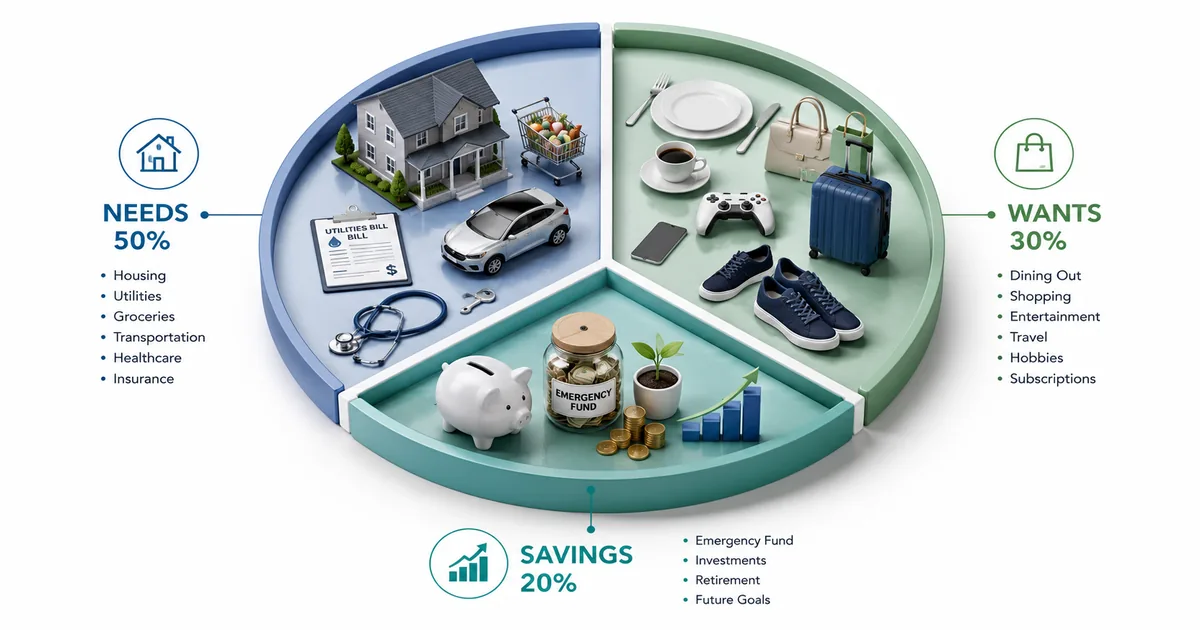
| 50/30/20 | 50% needs, 30% wants, 20% savings/debt | Beginners; straightforward households | Too broad if you're paying off debt aggressively |
| Zero-based | Every dollar assigned a job; income minus expenses = $0 | Aggressive debt payoff; detail-oriented people | Time-consuming; requires weekly attention |
| Pay yourself first | Auto-transfer savings/investment immediately at payday; spend the rest freely | People who hate tracking; automators | Doesn't address overspending on essentials |
The best budget is the one you'll actually use. If zero-based budgeting sounds exhausting, don't do it. Pick the pay-yourself-first method and automate aggressively. A simple system executed consistently beats a complex system ignored.
The Spending Audit: Do This Once
Before you build a budget, do a single 30-minute spending audit. Pull your last three months of bank and credit card statements. Categorise every transaction into: Housing, Food, Transport, Subscriptions, Entertainment, Health, and Other. Total each category.
Most people discover two things: (1) they spend significantly more on food than they estimated, and (2) they're paying for subscriptions they'd forgotten about. These two discoveries alone often unlock $150–$400/month of freed cash flow.
Pillar 2: Saving
Saving serves two distinct purposes that people often conflate: protection and growth. Your emergency fund is protection — it exists to absorb shocks so you don't go into debt when the car breaks down or the washing machine dies. Your retirement savings is growth — it exists to compound over decades into wealth. Treat them completely separately.
Emergency Fund: The Non-Negotiable Foundation
Without an emergency fund, you are permanently one crisis away from debt. The target: 3 to 6 months of essential expenses (not total spending — just the non-negotiables you'd need to survive if your income stopped). Where to keep it: a high-yield savings account paying 4–5% APY. It's liquid, it's earning something, and it's not so accessible that you spend it casually.
Start smaller. If 3–6 months feels impossible, start with $1,000. That single buffer eliminates most financial emergencies for most people — a car repair, a medical copay, a home appliance replacement. Get to $1,000 first, then build from there.
Savings Rate: The Number That Determines Your Financial Future
Your savings rate — the percentage of your income you save and invest — is the single most powerful variable in your financial life. It controls both how fast you accumulate wealth and how quickly you could stop working if you chose to.
| Savings Rate | Years to Financial Independence | What It Requires |
|---|---|---|
| 5% | ~66 years | Minimum effort; likely insufficient for retirement |
| 10% | ~43 years | Below recommended; better than nothing |
| 15% | ~37 years | Standard recommendation; comfortable retirement |
| 25% | ~32 years | Accelerated; aggressive but achievable for many |
| 50% | ~17 years | FIRE territory; requires deliberate lifestyle choices |
Assumes 7% average annual investment return (inflation-adjusted). Based on the Trinity Study and Mr. Money Mustache's savings rate analysis.
Pillar 3: Debt Management
Not all debt is equal. A mortgage at 6.5% on an appreciating asset is fundamentally different from a credit card at 24% APR. Treating them the same — either panicking about all debt or being cavalier about all of it — leads to bad decisions.
The Debt Priority Framework
| Debt Type | Typical Rate | Strategy | Priority |
|---|---|---|---|
| Credit cards | 18–29% APR | Eliminate immediately | 🔴 Urgent |
| Payday loans | 200–400% APR | Eliminate immediately; get a personal loan to consolidate | 🔴 Critical |
| Personal loans | 8–20% APR | Pay aggressively | 🟡 High |
| Car loans | 5–8% APR | Pay on schedule; consider prepaying | 🟡 Medium |
| Student loans (federal) | 4–7% APR | Standard repayment; explore forgiveness if eligible | 🟢 Low-medium |
| Mortgage | 5–7% APR | Pay on schedule; invest extra rather than prepaying | 🟢 Lowest priority |
Avalanche vs Snowball: Which Payoff Method to Use
The debt avalanche (pay highest-interest debt first) saves the most money mathematically. The debt snowball (pay smallest balance first) provides psychological wins that keep people motivated. Research by Harvard Business Review suggests the snowball method results in more people successfully paying off debt — because staying motivated matters more than optimising interest.
My recommendation: use the avalanche method if you have strong financial discipline. Use the snowball method if you've started and stopped debt payoff before. The best method is the one you'll finish.
Pillar 4: Investing
Investing is how you build wealth. Saving alone — even in a high-yield account at 5% — will not outpace inflation over the long run in ways that produce meaningful wealth. The stock market, despite its volatility, has returned approximately 10% annually over long periods — outpacing inflation significantly.
The Beginner Investment Hierarchy
- 401(k) up to the employer match — free money, tax-advantaged, non-negotiable starting point
- Roth IRA — $7,000/year (2026), grows tax-free, withdrawals tax-free in retirement
- 401(k) beyond the match — up to $23,500/year (2026)
- HSA if eligible — triple tax advantage; best account in existence for those with high-deductible health plans
- Taxable brokerage — for anything beyond tax-advantaged limits
What to Invest In as a Beginner
The research is clear: most investors — including professionals — underperform a simple index fund over long periods. For beginners, the evidence-based approach is:
- One total US stock market index fund (e.g., VTI — 0.03% expense ratio)
- Or a target-date retirement fund set to your retirement year (e.g., Vanguard Target Retirement 2055)
Target-date funds automatically rebalance from stocks toward bonds as you approach retirement. For someone who wants to invest properly without thinking about it, they're an excellent default. The cost of investment complexity — wrong asset allocation, emotional trading, chasing performance — typically exceeds the cost of simply buying and holding a low-cost index fund.
The Power of Starting Early
| Scenario | Monthly Investment | Start Age | Stop Age | Value at 65 |
|---|---|---|---|---|
| Early starter | $300 | 25 | 35 (10 years only) | ~$602,000 |
| Late starter | $300 | 35 | 65 (30 years) | ~$567,000 |
| Never stops | $300 | 25 | 65 (40 years) | ~$1,170,000 |
Assumes 8% average annual return. The early starter invests for 10 years, the late starter for 30 years — yet the early starter ends up with more money.
Pillar 5: Insurance
Insurance is the most undervalued pillar of personal finance. People pay attention to budgets and investments while ignoring the fact that a single uncovered event — a car accident, a serious illness, a house fire, a lawsuit — can erase years of financial progress in months.
Insurance transfers catastrophic risk to an insurer for a predictable cost. The math only makes sense for events that would genuinely be catastrophic — not every risk. Don't insure your phone screen ($100 problem); do insure your life and income (potentially million-dollar problems).
Insurance Priority by Life Stage
| Coverage | Who Needs It | Priority |
|---|---|---|
| Health insurance | Everyone | 🔴 Essential — medical bankruptcy is the #1 cause of personal bankruptcy in the US |
| Auto insurance (liability) | Everyone who drives | 🔴 Legally required in most states |
| Renters/homeowners insurance | Everyone with a home or possessions | 🔴 Essential — covers liability too |
| Term life insurance | Anyone with dependants | 🟡 Critical if others depend on your income |
| Disability insurance | Working adults | 🟡 Your ability to earn is your largest asset |
| Umbrella policy | Homeowners; anyone with assets | 🟢 Valuable and cheap ($150–300/year for $1M) |
Decision Framework: Where to Put Your Next Dollar
When you have an extra dollar — whether from a pay rise, a bonus, or freed-up cash after cutting an expense — this decision tree tells you exactly where it should go.
Where Does Your Next Dollar Go?
Step 1: Do you have $1,000 in savings? No → put it there first.
Step 2: Does your employer match 401(k) contributions? Yes → contribute enough to get the full match.
Step 3: Do you have high-interest debt (>7%)? Yes → pay it off aggressively.
Step 4: Do you have a 3–6 month emergency fund? No → build it now.
Step 5: Are you investing at least 15% of gross income? No → max Roth IRA first ($583/month for 2026), then 401(k).
Step 6: All of the above done? → Invest in taxable brokerage, or pursue specific goals (house, college, early retirement).
Common Mistakes Beginners Make
Mistake 1: Investing Before Eliminating High-Interest Debt
If you're carrying a credit card balance at 22% APR, investing in the stock market at an expected 10% return is a guaranteed way to lose money. Pay off the 22% debt first. The guaranteed return of debt elimination exceeds the probable return of investing.
Mistake 2: Lifestyle Inflation Consuming Every Pay Rise
The most expensive financial habit most people have is immediately upgrading their lifestyle whenever their income increases. When you get a raise, most of it should go to financial progress — savings, debt, investing — not to a nicer car or larger apartment. This single behaviour, practiced consistently, separates those who build wealth from those who earn good incomes but never accumulate much.
Mistake 3: Treating Insurance as Optional
Skipping health insurance, driving without adequate liability coverage, or renting without renters insurance to save $30–$50/month is false economy. These decisions save hundreds but expose you to tens of thousands in potential losses.
Mistake 4: Waiting Until You "Have Enough Money" to Start
Most people plan to start investing when they earn more. This is backwards. The habit of investing — even $50/month — is more important than the amount. The habit compounds. The procrastination compounds too, just in the wrong direction.
Mistake 5: Keeping All Savings in a Standard Savings Account
The national average savings rate is 0.45% APY. A high-yield savings account at an online bank pays 4–5% on the same FDIC-insured deposits. On $10,000, that's the difference between $45/year and $450/year. Move your savings. It takes 10 minutes.
Mistake 6: No Will, No Beneficiaries
If you have any assets and haven't designated beneficiaries on your retirement accounts or named someone in a will, your wishes may not be honoured. This isn't morbid — it's responsible. A basic will takes an hour and costs $100–$300 with an online service.
Myths vs Facts
"You need a high income to build wealth."
FACT: Wealth is built by the gap between income and spending, consistently invested over time. A $50,000 earner with a 20% savings rate builds more wealth than a $150,000 earner spending it all. Income accelerates wealth building; it doesn't create it.
"Investing is too risky for regular people."
FACT: Not investing is the risk. Keeping all your savings in cash or a low-yield account means inflation erodes purchasing power year after year. A diversified index fund portfolio, held for 20+ years, has never lost money over any historical period.
"I'll start saving for retirement when I'm older and earning more."
FACT: Compound interest rewards early starters disproportionately. $300/month from age 25–35, then nothing, beats $300/month from age 35–65. The person who invests for 10 years ends up with more than the person who invests for 30 years — because of the 10-year head start.
"A budget means I can't spend on things I enjoy."
FACT: A budget is permission to spend. When you know your savings are funded and your bills are paid, spending on what you genuinely enjoy is guilt-free. Most people who don't budget spend anxiously — never sure if they can afford things — and still don't save.
Starter Checklist: Your First 30 Days
✅ Personal Finance 101 — 30-Day Starter Checklist
UK, India, and Canada
UK: The five pillars apply universally, but the vehicles differ. UK residents have ISAs (tax-free savings and investment accounts, £20,000 annual allowance), workplace pensions (auto-enrolment with employer contributions), and FSCS deposit protection to £85,000. The budgeting principles are identical. MoneyHelper at moneyhelper.org.uk provides free, impartial UK-specific guidance.
India: The framework translates directly. The specific vehicles differ: EPF (Employee Provident Fund) replaces the 401(k), PPF and NPS for retirement savings, and term plans from LIC or private insurers for life insurance. The prioritisation logic — employer contributions first, high-interest debt second, long-term investing third — applies identically. SEBI's investor education at investor.sebi.gov.in.
Canada: Canadian residents have TFSAs (Tax-Free Savings Accounts — arguably superior to Roth IRAs for flexibility), RRSPs (equivalent to Traditional IRA), and CPP/OAS for retirement foundation. The CDIC protects deposits to $100,000. FCAC's financial literacy resources at canada.ca.