Federal Repayment Plan Overview
| Plan | Term | Payment | Best For |
|---|---|---|---|
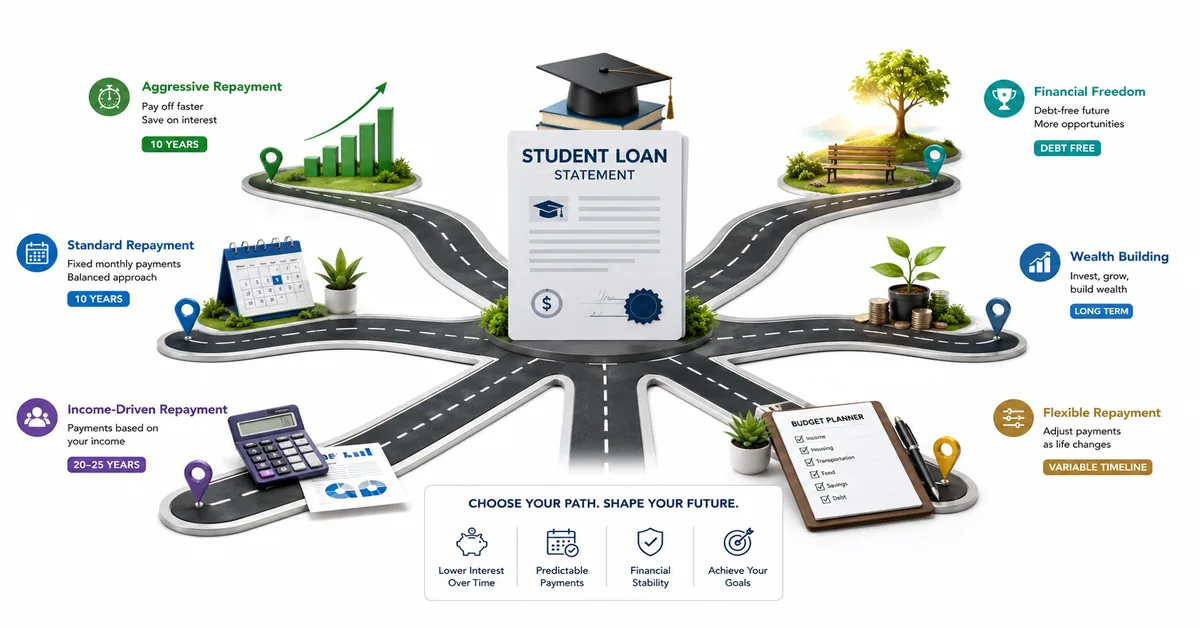
| Standard | 10 years | Fixed — highest monthly payment | Paying off fastest; least total interest |
| Graduated | 10 years | Starts low, increases every 2 years | Low income now, expecting growth |
| Extended | Up to 25 years | Fixed or graduated; lower payment | Need lower payment; not pursuing forgiveness |
| Income-Driven (IDR) | 20–25 years | % of discretionary income; forgiveness after | High debt relative to income; PSLF eligible |
Source: studentaid.gov/repayment. IDR plans have specific income and loan type eligibility requirements.
The Standard 10-Year plan is the default. It minimises total interest paid and is the right choice for borrowers who can afford the payment and don't qualify for or aren't pursuing forgiveness. If the standard payment is unaffordable, IDR plans are the next step to consider — not refinancing.
Income-Driven Repayment Plans Explained
IDR plans set your monthly payment as a percentage of your discretionary income, adjusted annually based on your tax return. After 20–25 years of qualifying payments, any remaining balance is forgiven. Four main IDR plans exist:
- SAVE (Saving on a Valuable Education): The newest and most generous IDR plan. Caps undergraduate loan payments at 5% of discretionary income (10% for graduate loans). Forgiveness after 20 years for undergraduate-only borrowers. The SAVE plan was under legal challenge as of 2026 — check studentaid.gov for the current status.
- PAYE (Pay As You Earn): Caps payments at 10% of discretionary income; forgiveness after 20 years. Available to borrowers who were new borrowers on or after October 1, 2007.
- IBR (Income-Based Repayment): Caps payments at 10% of discretionary income for recent borrowers (15% for older borrowers); forgiveness after 20–25 years. Most widely available IDR plan.
- ICR (Income-Contingent Repayment): Caps payments at 20% of discretionary income or what you'd pay on a 12-year fixed plan, whichever is lower. Forgiveness after 25 years. The oldest IDR plan and usually least favourable.
Tax on IDR forgiveness: historically, forgiven amounts after 20–25 years of IDR were considered taxable income in the year of forgiveness. Legislation passed for 2021–2025 created a temporary exemption. As of 2026, confirm the current tax treatment with a tax advisor before counting on tax-free forgiveness. PSLF forgiveness is permanently tax-free.
Public Service Loan Forgiveness (PSLF)
PSLF forgives the remaining balance on federal Direct Loans after 120 qualifying monthly payments — exactly 10 years — while working full-time for a qualifying employer. Qualifying employers include:
- Government organisations (federal, state, local, tribal)
- 501(c)(3) nonprofit organisations
- Other nonprofits that provide qualifying public services (public health, public education, public safety, etc.)
Payments must be made on an IDR plan while working for the qualifying employer. PSLF forgiveness is permanently tax-free — the forgiven amount is not counted as income. Certify your employment annually at studentaid.gov to ensure you're on track. Don't wait until year 10 to confirm — annual certification catches issues early.
Should You Refinance?
Refinancing federal student loans with a private lender replaces them with a private loan at a (potentially lower) interest rate. The savings can be real — but so are the tradeoffs:
What you lose by refinancing federal loans: access to IDR plans, PSLF eligibility, federal deferment and forbearance options, income-driven forgiveness, and potential future forgiveness programs.
Refinancing federal loans makes sense only if: you have a stable high income and don't plan to use IDR; you don't work in public service (no PSLF eligibility); you have excellent credit (720+) and can get a meaningfully lower rate; and you have an emergency fund so you won't need federal forbearance.
Refinancing private student loans (which already have no federal protections) is straightforward — if you can get a lower rate, do it.
How to Choose the Right Plan
Use the federal Loan Simulator at studentaid.gov — it takes your exact loan balance, income, and family size and shows projected monthly payments and total cost under every plan side by side. This is the most practical first step for any borrower confused about their options.
- If you work in public service: Enrol in IDR (preferably SAVE or PAYE) immediately and certify PSLF eligibility annually. The goal is 120 payments, not paying off the loan.
- If your debt is low relative to income: Standard 10-year plan pays off fastest and costs least. IDR offers no forgiveness advantage if you'd pay it off before 20 years anyway.
- If your payment is unaffordable: Enrol in an IDR plan. Your payment can be as low as $0 in very low income years — still counts as a qualifying payment for forgiveness.
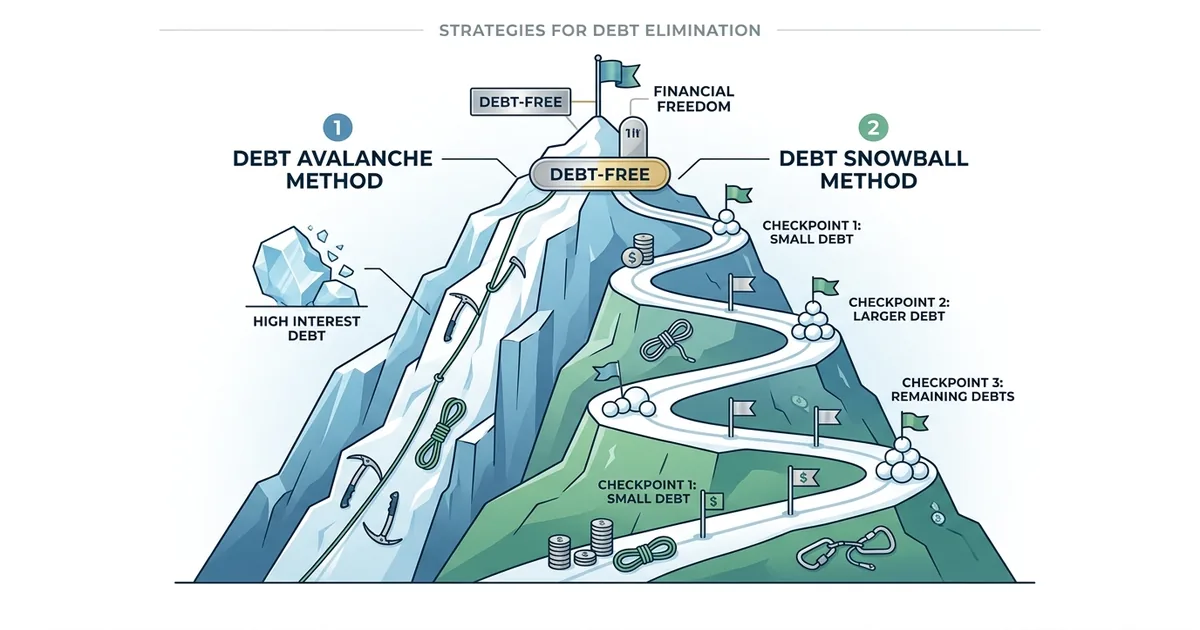
- If you have private loans: No IDR or forgiveness options. Refinance if you can get a lower rate. Pay aggressively using avalanche method.
Student Loan Systems in the UK, India, and Canada
UK — Plan 2 and Plan 5 Student Loans: UK student loans work very differently. Repayment is income-contingent — you repay only if you earn above a threshold (£27,295/year for Plan 2; £25,000 for Plan 5). Repayments are 9% of income above the threshold, deducted automatically from salary. Plan 2 loans are written off after 30 years regardless of remaining balance. The interest rate is linked to RPI inflation. Because of the income-contingent structure and long write-off period, many UK graduates will never fully repay their loans — making the UK system closer to a graduate tax than traditional debt. Guidance at gov.uk/student-finance.
India — Education Loans: Indian education loans are typically offered by banks at interest rates of 8–12%. Repayment begins after the course ends plus a moratorium period (typically 6–12 months). Loans are not income-contingent — fixed EMIs are required regardless of income. Interest paid on education loans is deductible under Section 80E for up to 8 years. Student loan forgiveness does not exist in India outside of specific state government schemes for certain beneficiary groups.
Canada — NSLSC and Repayment Assistance: Federal student loans in Canada are managed through the National Student Loans Service Centre (NSLSC). The Repayment Assistance Plan (RAP) reduces monthly payments for those with low income — similar in concept to US IDR but with different thresholds. Loans are forgiven after 15 years for disabled borrowers through the Repayment Assistance Plan for Borrowers with Permanent Disability. Provincial student loans may have separate repayment terms. More at canada.ca.