What Financial Stability Actually Means
Financial stability is not a number in a bank account. It's a state in which your essential expenses are reliably covered, you have enough buffer to absorb normal life surprises without borrowing, and you're making consistent progress toward long-term security. You can be financially stable on $35,000/year and financially unstable on $150,000/year — the difference is the ratio of income to spending and the presence of savings infrastructure.
True financial stability has three properties: it handles disruptions without crisis (a car repair doesn't require a credit card), it maintains forward momentum (you're making progress toward goals even when life is imperfect), and it provides options (you could leave a bad job, absorb a temporary income loss, or handle a family emergency without financial catastrophe).
The Five Stages of Financial Stability
Financial Stability Ladder
Financial Stability by the Numbers
| Stage | Emergency Fund | Debt Status | Investing | Income Sources |
|---|---|---|---|---|
| Stage 1: Survival | $0 (goal: avoid new debt) | Managing minimums | None | 1 (essential) |
| Stage 2: Buffer | $1,000 | No new debt being added | Employer match only | 1 |
| Stage 3: Foundation | 3–6 months expenses | No debt above 7% APR | 15%+ of income | 1–2 |
| Stage 4: Growth | 6 months (fully funded) | Only low-rate debt (mortgage) | Max tax-advantaged accounts | 1–2 |
| Stage 5: Resilience | 12+ months accessible | Minimal or none | Taxable investing + max-funded accounts | 2+ |
Stage 1: Survival
Stage 1 is the foundation: ensuring essential expenses — housing, utilities, food, transportation, insurance, minimum debt payments — are reliably covered each month. If you're behind on rent, carrying overdraft fees, or regularly missing bill due dates, you're in Stage 1.
The goal at Stage 1: Stop the financial bleeding. This means two things: ensuring income covers essential expenses, and stopping any new debt accumulation (other than emergencies).
Priority actions: If expenses exceed income, reduce fixed costs or increase income immediately — this is not optional. Contact any creditors about hardship programs. Use any available financial assistance. The goal is a zero or positive monthly cash flow before anything else.
Stage 2: Buffer
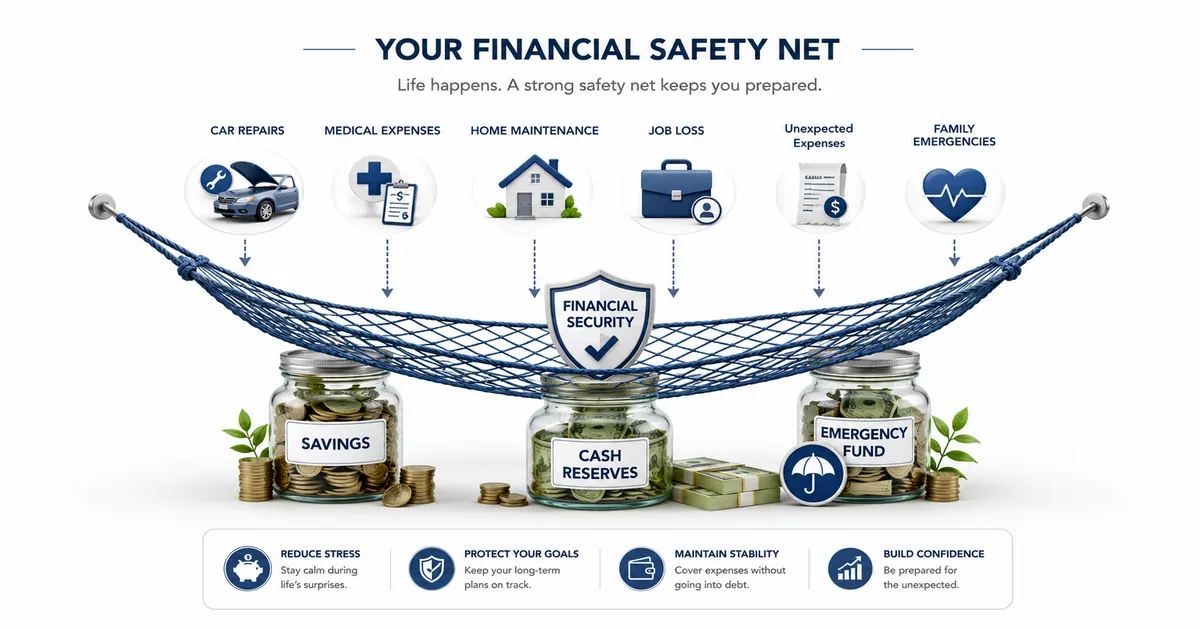
Once expenses are covered and you're not falling behind, Stage 2 is building a $1,000 emergency buffer. This seemingly small amount has an outsized impact on financial stability because it converts the most common financial emergencies — a car repair, a medical copay, a home appliance breakdown — from crises requiring debt into manageable inconveniences.
How to build the buffer quickly: temporarily reduce all non-essential spending for 4–6 weeks, sell unused possessions, or pick up temporary additional income. The goal is speed — getting to $1,000 and establishing the buffer in 4–8 weeks rather than months.
Once the buffer exists: set up an automatic small transfer to savings on payday. Even $25. This begins building the habit and infrastructure for Stage 3.
Stage 3: Foundation
Stage 3 is the most comprehensive and takes the longest to achieve. It involves three parallel goals that can be worked on simultaneously:
- Full emergency fund: 3–6 months of essential expenses in a high-yield savings account
- Employer match captured: Contributing enough to your 401(k) to receive the full employer match — never leave this on the table
- High-interest debt eliminated: All debt above approximately 7% APR paid off — typically credit cards first, then high-rate personal loans
The allocation of available cash flow: split it among all three goals simultaneously rather than doing them sequentially (except the $1,000 buffer, which comes first). Eliminating high-interest debt takes priority over growing the emergency fund above $1,000 because the guaranteed return of debt elimination beats the certain cost of high-rate interest.
Stage 4: Growth
Stage 4 is where wealth building begins in earnest. You're investing at least 15% of gross income, your emergency fund is fully funded, you have no high-interest debt, and your net worth is growing consistently.
The primary investment vehicle sequence: max employer 401(k) match → Roth IRA ($7,000/year in 2026) → 401(k) up to the annual limit ($23,500 in 2026) → HSA if eligible ($4,300/year individual in 2026) → taxable brokerage for anything additional.
At Stage 4, the investment strategy matters less than the consistency. A simple index fund allocation held consistently through market cycles produces better outcomes than a sophisticated strategy executed inconsistently.
Stage 5: Resilience
Stage 5 is genuine financial resilience: you have meaningful invested assets, multiple income sources or enough runway to absorb extended disruption, and the financial infrastructure to handle almost anything life throws at you without crisis.
Markers of Stage 5: you have 12+ months of expenses in accessible assets (not just a savings account — invested assets that could be liquidated), you have at least two income sources or a business, you have full estate planning in place (will, power of attorney, healthcare directive, updated beneficiaries), and you're on track to retire on your own terms.
Stage 5 isn't static — it requires maintenance. Review annually. Life changes — job loss, divorce, major health event — can temporarily move you back a stage. The framework is a direction, not a permanent achievement.
Stability Milestones Checklist
✅ Financial Stability Milestones
Recovering from Setbacks
Financial setbacks — job loss, medical event, divorce, business failure — are not failures of the system. They're part of life. The stability framework is designed to be resilient to setbacks, and it's designed to provide a clear re-entry point when they happen.
After a major setback: identify which stage you're currently in, go back to working that stage's priorities, and don't try to skip stages in recovery. A person who loses a job and depletes their emergency fund drops back to Stage 2 — not Stage 0. The skills, habits, and financial literacy developed at higher stages remain. Recovery is faster than initial build the second time.